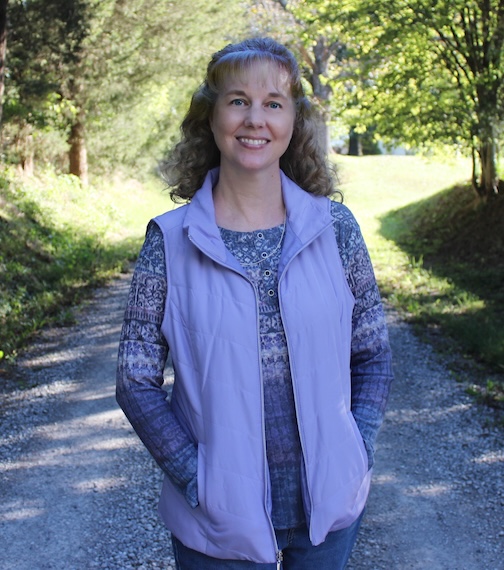
A few months ago, I did an interview with John Zechiel, a sheet music transcriber who has worked with a wide variety of artists, doing note-for-note transcriptions of their recordings. The other transcriber I’ve done the most proofing for is Marcia Wells, who actually does a lot of solo piano arrangements of classic and contemporary hymns as well as patriotic songs. We’ve been working together since 2018 and this seemed like a really good time to do an interview, so enjoy!
KP: Hi Marcia! How are things in Southern Illinois today?
MW: Hello Kathy! After a very hot late summer, we are finally getting some cooler temperatures. I love being outdoors so I have enjoyed doing some work in the yard and cleaning out flowerpots this week.
KP: We have been working together for a lot of years now! I did an interview a few months ago with John Zechiel, who also transcribes piano sheet music, but your roles are not the same. Most of the sheet music I proof-read for John are note-for-note transcriptions of solo piano recordings that are submitted by the composers. The work that you do (that I’m familiar with, anyway) is more like as an arranger as well as a transcriber. It seems like most of your sheet music is with both contemporary and classic hymns, transcribing them both singly and as medleys. Is that accurate? There have been several patriotic medleys as well.
MW: Yes. What I have found is that many churches like to incorporate some of the newer contemporary songs, but the music available online is often limited to chord charts and lead sheets. When a song leader and/or choir is accustomed to hearing the melody line from the hymnal, it is sometimes difficult to follow chords alone. I try to combine the melody line with additional flowing notes to fill in the gaps and make the music sound more complete. I do this with both older hymns and newer songs so that each piece can function either as a piano solo or as accompaniment for singers. I’ve also arranged several patriotic songs and medleys in this same style. I’m thankful that our small community hosts special services on the town square for Memorial Day and Veteran’s Day each year, and it’s meaningful to create music that the community can sing along to.
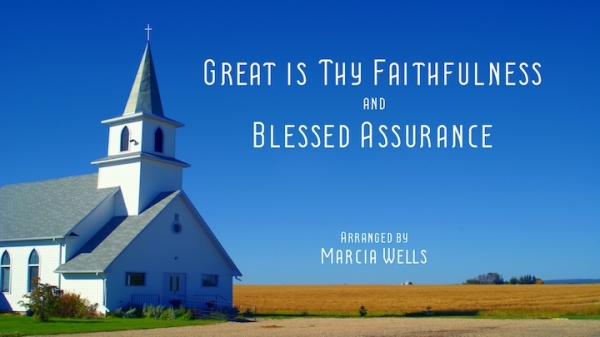
Sheet music covers.
KP: Your community is very fortunate to have you! How do you choose which hymns and songs to transcribe?
MW: Honestly, I usually sit down at the piano and begin playing, and I let the Lord guide my heart towards a melody. Sometimes a hymn comes to mind immediately; other times I’ll play through several themes until one settles in and feels right. From there, the arrangement grows naturally. It’s almost like the piece chooses me rather than the other way around. It’s a very prayerful process, and I’m grateful for the moments when inspiration meets purpose.
KP: You have arranged and transcribed quite a few of the songs by CityAlight. Are those commissions or do you just really enjoy their music?
MW: I really do enjoy CityAlight’s music. Their writing has a timeless quality like some of the old hymns. The way they shape melody and harmony feels very natural to someone who grew up playing traditional hymns. Their songs lend themselves beautifully to congregational singing, and the message in their lyrics is always rich and meaningful.
My arrangements aren’t formal commissions, but I believe I’m currently the only arranger transcribing and creating their piano sheet music for Musicnotes. I approach their songs the same way I do my other arrangements in that I combine the melody line with an accompaniment-style piano part so that the congregation can easily follow along.
KP: That’s really interesting! I know you are also a church musician. Do you play mostly your own arrangements for services? I would imagine a lot of the congregation must enjoy wondering what you are going to play for them each Sunday!
MW: I play every Sunday for congregational singing and for the offertory at our small county church. We love the older hymns, and we’ll occasionally add in a newer contemporary song too. Interestingly, I usually just play straight from the hymnal and improvise as I go. If a hymn has four verses, I might play something a little different for each one. It keeps the music fresh and helps support the meaning of the text.
I often use part of one of my solo arrangements for the offertory. And yes, I think I do keep the congregation guessing a bit. Some Sundays I’ll play something slow and meditative, and other times it’s more upbeat and bright. It’s a joy to choose what feels right for that particular service.
KP: You have your arrangements available from your own website as well as on MusicNotes.com. Does MusicNotes.com commission you to arrange certain songs or do you choose which ones you’re going to work on?
MW: Yes, I offer digital sheet music both on my website and through Musicnotes. I’m a Signature Artist with Musicnotes, and while they occasionally suggest new or trending songs, I ultimately choose which pieces I want to arrange. On my own website, I only publish older hymns and songs that are in the public domain. For anything still under copyright, Musicnotes handles all of the licensing and legal work. Because of that agreement, those arrangements are offered exclusively through Musicnotes. I receive the same commission whether a song is requested or whether I simply submit an arrangement I’ve created on my own, so I enjoy the freedom to work on music that inspires me.
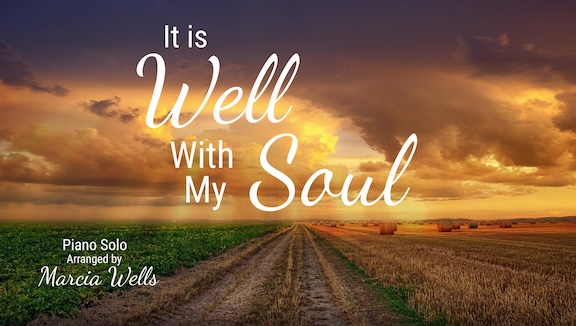
More sheet music covers.
KP: Are you planning to arrange a lot of Christmas music in the coming months?
MW: I love Christmas music and have arranged many individual songs as well as several medleys over the years. I try to create at least one new Christmas arrangement each year. I usually begin working on Christmas music during the summer months so the arrangements are available by September or October. That gives pianists plenty of time to practice before the Christmas season begins. One of my favorite Christmas arrangements I’ve ever done is a four-hand arrangement of “Carol of the Bells” — it was such a fun and creative project.
KP: Oooh! That sounds like fun!
Do you also compose your own music?
MW: No, I’m not really a composer — I’m very much an arranger. I’ve tried to write original music, but after playing so many songs across so many genres for so many years, I usually find that any melody I start to create quickly reminds me of something that already exists. I do love experimenting with chords and harmony, though. In many of my arrangements you’ll hear chords that aren’t part of the original song. Adding those touches helps my solos feel fresh and unique, even when the melody itself is familiar.
KP: I agree!
Okay, let’s back up and get to know you a little better. Where were you born and where did you grow up?
MW: I’ve lived in southern Illinois all my life. Our family has been on the same farm for generations, and I’m the sixth generation to make my home here. It’s a beautiful area and a wonderful place to grow up and to stay rooted.
KP: How old were you when you started piano lessons?
MW: I honestly don’t remember a time when I wasn’t playing the piano. My mother played and I often picked out melodies by ear, so music was always part of our home. I suppose my first “official” lessons were with her around age four, using the John Thompson method books. It feels like the piano has always been a part of my life.
KP: I started with the Thompson books, too!
You mentioned on your website that both of your parents are or were church musicians, so you must have come from a very musical household!
MW: Yes, music has always been a part of our home. Both of my parents were deeply involved in church music. They sang together in a gospel quartet for several years, and my dad has been a church song leader since before I was born. My mother plays the piano and has served as a church pianist for many years. In our area, the small county churches traditionally held weeklong spring and fall revivals, and my parents were often asked to provide music for those services. Some of my favorite childhood memories are listening to them practice together in the living room. Those moments shaped my love for church music more than anything else.
The Northern Lights
KP: Do you have musical brothers and sisters?
MW: I have one brother. He was involved in band during school, but he didn’t really pursue music beyond that. I ended up being the one who stayed most connected to church music and piano.
KP: Did you play in any bands or orchestras?
MW: I started in beginning band in fourth grade on the clarinet and continued playing through eighth grade. When I reached high school, I moved over to the keyboard and played the bass line for concert band, pep band, and even marching band with a battery pack! I also accompanied the school choir on piano. For band camp and competitions, keyboards weren’t always included, so I learned several of the musical percussion instruments — marimba, glockenspiel, and xylophone. I occasionally tuned and played the timpani as well. I also played piano for the jazz band at band camp, which was one of my favorite experiences. It was a fun mix of roles, and I loved being able to contribute wherever I was needed.
KP: Do you play other instruments in addition to the piano?
MW: I tried taking violin lessons with my daughter for a short time, but I quickly learned that my fingers were meant for the piano, not for stringed instruments. I enjoyed the experience, but the violin definitely confirmed that the keyboard is where I belong.
KP: Were you a music major in college?
MW: No, I wasn’t a music major in college. I played piano with the jazz band for a semester and took several general music classes during my undergraduate years, but I was a science major. I quickly realized I couldn’t juggle both paths, so I focused on Physiology in preparation for an advanced degree as a Physician Assistant.
At the time, the music programs were centered almost entirely around teaching or performance. Now there are so many options in digital arranging and music technology, and I would have loved to explore those if options like that had been available then.
KP: Yes, the music world has changed pretty drastically, hasn’t it?
You mentioned that you were a Physician Assistant. How long ago was that?
MW: I graduated from PA school in 2000 and practiced clinically for about twenty years. Most of that time was spent in a small private pediatric practice, which I loved. I really enjoyed meeting families, getting to know them over the years, and even caring for the next generation as they grew up. Those long-term relationships were one of the most meaningful parts of my work.
KP: I experienced that with teaching piano in students’ homes and getting to know the whole family, too. It was well worth the extra effort to drive around to students’ homes rather than having them all come to mine. I didn’t have to keep the house as neat, either!
Are you still doing work in the health care field?
MW: I still keep my license current, and I’m involved in some online research — mostly in oncology and occasionally with clinical trials. It’s a different pace than clinical practice, but I appreciate staying connected to the medical field.
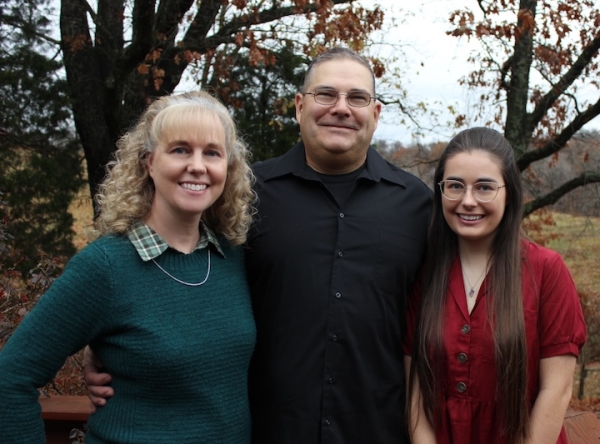
The Wells Family
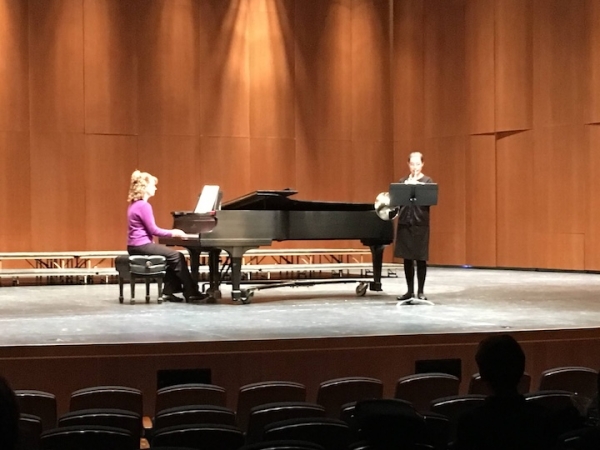
Marcia accompanying her daughter in 2017.
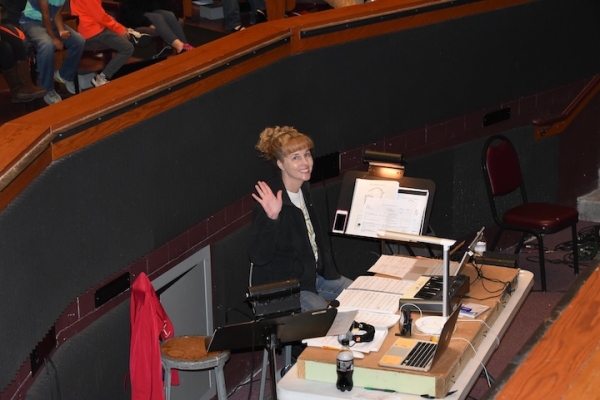
Marcia in the "pit."
KP: What kind of work does your husband do?
MW: My husband and I met in college. He was also a science nerd! He works in environmental geology, focusing on regulatory compliance and groundwater sampling, often on government contracts. A couple of years ago, he also completed a local emergency medicine course and became a licensed EMT. He works a few shifts a month as an EMT in his “spare time,” and he really enjoys being able to serve the community in that way. He’s also proud to be an Army veteran, and that experience has shaped a lot of who he is and how he approaches his work.
KP: It sounds like your daughter is quite a musician, too. Which instruments does she play?
MW: Yes, she’s an excellent and accomplished French horn player. She was a music performance major during her undergraduate years and loved playing in both the wind ensemble and the orchestra. She also had some wonderful opportunities to participate in special projects on the side. She plays the piano as well and started lessons with my mom when she was about four or five. Music has always been a big part of her life. She’s now in graduate school for library science and works at a magnet arts elementary school, which has been a perfect fit for her interests and strengths.
KP: Does she also do arranging?
MW: No, she doesn’t do any original arranging. Her main passion has always been playing classical music in the orchestra. That’s really where she feels most at home musically.
KP: Who and what have been some of the inspirations in your life?
MW: The most influential people in my musical life have been my parents. Watching them devote so much time to the music ministry as I was growing up inspired me to continue arranging as a second career. Their dedication shaped my love for church music more than anything else. As far as piano influences, some of the musicians who have inspired me over the years are Anthony Burger, Stan Whitmire, and Kim Collingsworth. Their styles, creativity, and passion for gospel music have had a lasting impact on how I approach arranging.
KP: Who are some of your favorite recording artists?
MW: That’s always a tough question for me because I listen to such a wide range of genres — everything from big band and Broadway musicals to hymns, CCM, and classical. I really appreciate the depth and variety of music from Bill and Gloria Gaither, and I especially enjoy hearing choirs sing their songs with all the harmony blended together. As I mentioned earlier, I also love CityAlight. Some of the artists who frequently show up on my playlist are CeCe Winans, Phil Wickham, Brandon Lake, and Elevation Worship, as well as Broadway soundtracks. I enjoy a mix of styles, and each of them brings something unique that I appreciate.
KP: If you could have any three wishes, what would they be?
MW: That’s another tough question, but I think my three wishes would be fairly simple. First, I would wish to continue creating music for as long as I’m able, so I can keep inspiring others and contributing to the church music community. Second, I would wish for lasting happiness and health for my family because that’s always at the center of my heart. And third, I would wish for those who listen to my music to be inspired to follow Jesus or to continue walking with Him. If my arrangements can encourage someone in their faith, that would mean more to me than anything else.
KP: Is there anything else you’d like to “talk” about?
MW: Fun fact — I absolutely love playing in and watching musical theater! I’ve played the keyboard parts for several productions at our local community college. In some shows I even covered the string books on keyboard, and once I played percussion. A couple of my favorite productions to play have been Tarzan (written by Phil Collins) and Shrek, mostly because the music called for so many fun and quirky sounds. My favorite musical to watch live is Wicked. Unfortunately, many local theaters now use prerecorded soundtracks to make rehearsals easier, but I still think live music is the better choice!
KP: I agree!!!
Many thanks to Marcia Wells for taking the tine to do this interview! For more info about Marcia and her music, be sure to visit
her website and her
Artist Page here on MainlyPiano.com!
Kathy Parsons
September 2026