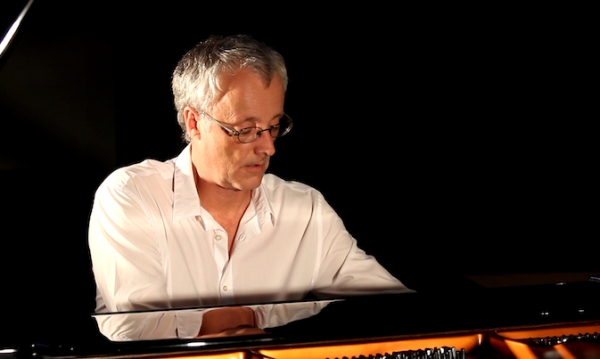
I have been reviewing Ralph Zurmühle’s music since his 2007 release, his third album,
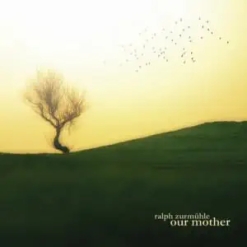
Our Mother. I was so impressed with that album that I went back and reviewed his first two albums as well. Ralph has released eight CD/albums including his new one, and one live studio session that is available on vinyl. His new release,
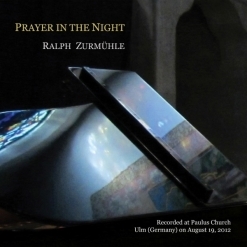
Prayer In The Night, is also a live album, recorded at a church in Germany at night. It’s an amazing album and I was anxious to talk to Ralph about the music. This is our third interview, and links to the earlier interviews as well as to all of my reviews are available on Ralph’s
Artist Page here on MainlyPiano.com.
KP: Happy New Year, Ralph! How are things in Spain?
RZ: Happy New Year to you as well, Kathy. The weather in Spain is cold. We just had two rainy weeks without sunshine and one day of snow here near Barcelona. Can you believe it? We are so spoiled with sunshine that two weeks like this feels “miserable” to us. ☺
Click on album covers
to go to Kathy's reviews.
KP: [laughing] It sounds a lot like Oregon to me!
You are starting the year off right with a new album releasing on January 19, 2026. And what an amazing album it is! Let’s talk a little bit about the background of the album before we get more specific about the pieces themselves. You actually recorded Prayer In the Night in 2012. Why did it take so long to get it released?
RZ: Three reasons. One is that my label for the album, eQuinox, back then objected to the release because two tracks were re-recordings from eQuinox and the contract didn’t allow that. I decided not to renew the contract in 2022 and I am now free to release the album. I then waited 3 years, which is another reason. As any other artist I have moved on over the last 13 years. So, I was a little bit hesitant to release older works. And thirdly, considering the condition of our world at this time, this album, in a way, represents my prayer for peace and better times.
KP: It’s amazing how things work themselves out sometimes! What made you decide to do concerts in churches and monasteries in Europe?
RZ: Sacred spaces such as churches invite us to contemplate and bring us into contact with the other, more mystical side of our being. Such sites require silence or music that corresponds with their architectural structure, their spiritual purpose; music that communicates with the space. Critics and fans have often emphasized that silence is an important component in my music. In this regard, I consider many of my compositions as invitations to prayer, contemplation or meditation. The year following the release of this album, I had a concert tour in different churches throughout Catalonia.
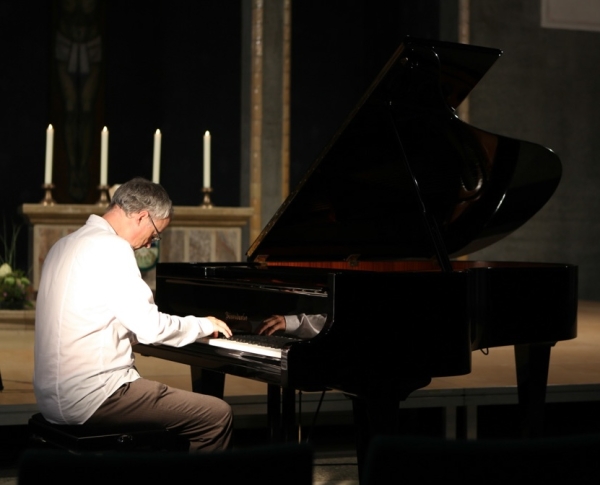
KP: Prayer In The Night was recorded live in Paulus Church in Ulm, Germany. Did you have an audience present or was it just the people who were doing the recording that were there?
RZ: Just Rolf (the sound engineer), Pamela (my wife) and I.
KP: How or why did you choose that particular church for the recording?
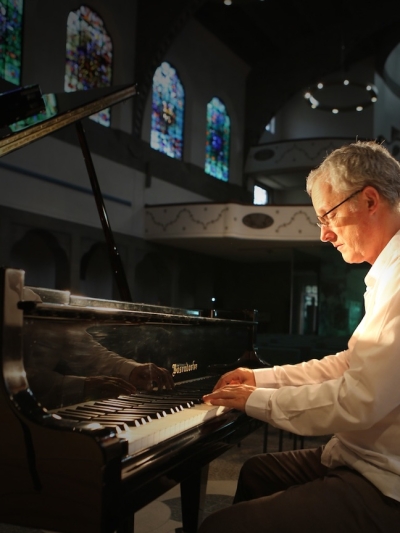
RZ: The church is known as the “concert church” in that region of Germany. It has a beautiful Bösendorfer grand piano and fantastic acoustics. Rolf Bäuerle, who I got to know through my music, brought it to my attention during a meeting in July 2012 and we spontaneously decided to organize the recording session.
KP: Very sadly, your father passed away a week before the recording session was scheduled. That must have made it more difficult to focus on the music and prepare to record. Or did it sharpen your focus?
RZ: The week before the recording was difficult, emotionally above all. Then, the recordings themselves were also somewhat complicated because of technical issues. Despite these unfavorable circumstances, I was absolutely focused during the session, while at the same time I had a feeling of not being 100% present.
KP: How did you choose the first ten pieces for the live album?
RZ: The crucial point was that the recording was in a church. So, I chose compositions that give the music time to develop, unfold and fade, compositions that use silence as an important element.
KP: You mentioned that the night of the recording, there were a lot of technical difficulties. What were some of them?
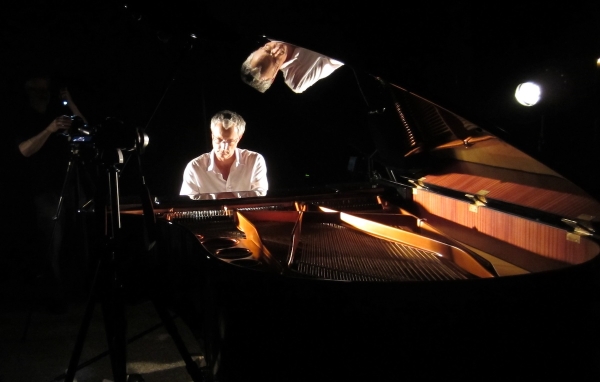
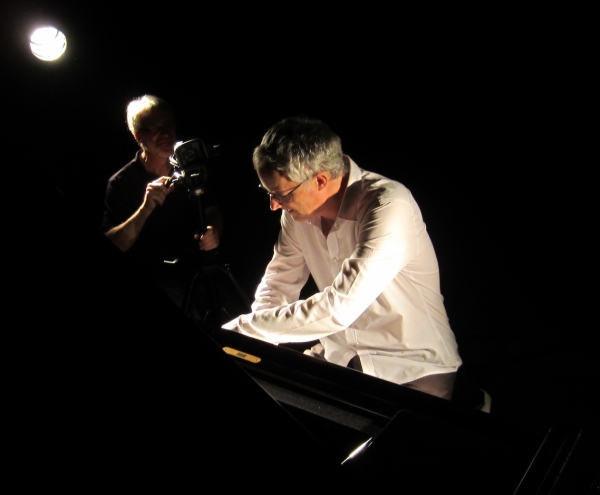
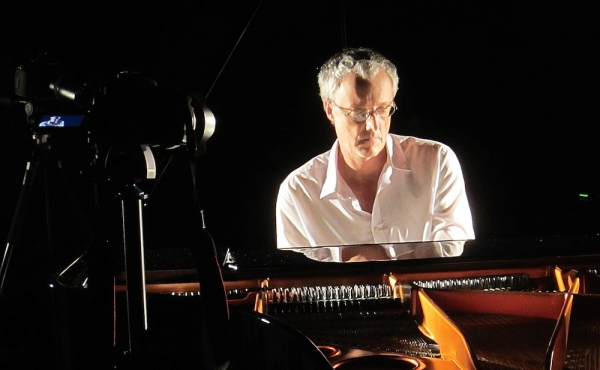
RZ: Yes, the problem was we wanted to do both audio and video recordings at the same time. Rolf was in charge and he did his best to accommodate both, but it resulted in various interruptions, noises, distractions, etc. I had to play the same pieces over and over again. Also, the piano chair was very squeaky and we had to fix that as well. After a couple of hours, we decided to do the video material the next day. So, from then on we just focused on the recordings and I was finally able to play an entire track without noises in the background.
KP: I read that you recorded ten pieces and then took a break. Were you planning to release the album as those ten pieces or was going back to the piano after a break and improvising part of the original plan?
RZ: The initial plan was to release about 12-13 tracks from my repertoire. However, two or three of those tracks didn’t make it into the album. Instead, we decided to include the two improvisations which happened accidentally, so to speak, at the end.
KP: The two improvisations that are the eleventh and twelfth tracks on the album have interesting stories. Care to talk about them?
RZ: Well, I was exhausted at the end of the recording session. I felt the effects of the intense days before with little sleep and the 5-6 hours of very concentrated work that evening. Nevertheless, after a while I went back to the piano, sat down and played around with a motive based on an Arabic scale I discovered just a couple of weeks before. It was all improvised, but I had a lead with that particular motive. This piece is called 'Improvisation 1' on the album. Then, I stopped, sat there for a moment, quiet, it was midnight, and suddenly I had the feeling or more accurately, the illusion of hearing church bells ringing and I started to play again. Out of nothing, no motive, nada. I just punched a chord, a D minor 9, and then it took off, like in a trance, for 6 minutes. My hands didn't follow me; I followed them all the way through. After that, absolute silence in the church. The three of us had the feeling that something extraordinary had just happened. I said to Rolf, what a pity that the recording session had ended. And Rolf replied that the moment when he saw me going back to the piano he started the recording again. So, we had a recording of both pieces.
KP: Amazing! On the album, the last two pieces are listed as “Improvisation Ulm I” and “Improvisation Ulm II.” Was the recording session the only time you’ve performed those pieces or have you developed them and given them different titles?
RZ: Yes, I liked those pieces very much and decided, after reworking or refining them, to release them on the next album
Reflections under the titles “The Oracle” and “At the Threshold.” I performed “The Oracle” in various concerts, especially in benefit concerts to raise funds to support Syrian refugees. “At the Threshold”, that 100% midnight improvisation, I performed just once, at Little Big Beat Studios in Liechtenstein, a live studio recording session that was released on vinyl. This session took place in 2020 during COVID, on the 19th of August, the exact same day as the initial improvisation in Ulm. I was not aware of that at the time, but what synchronicity.
KP: Indeed! With the many pieces you have recorded over the years, how or why did you choose “Our Mother” to begin the album?
RZ: That I chose “Our Mother” as the first track, is no coincidence. I wanted to start this musical “prayer” with a focus on our Earth and the feminine aspect of our nature. Something that is lacking in this world out of balance where nearly everything is ruled by distorted versions of male principles that emphasize power, greed, control etc., principles that have brought us on a path towards total destruction.
KP: You mentioned in an email that the album was recorded in a Christian church and two of the tracks (including one of the improvisations) reflect Hebrew and Arab/Islamic influences. Was that intentional?
RZ: Yes and no. No, because this was not my initial intention. Yes, because it has always been my conviction that all world religions, at their core, strive for the same values. They all believe in a higher force that watches over us as we try to evolve as individuals and as humanity. I myself am protestant by birth.
KP: Are you still doing a lot of film music?
RZ: Sometimes, but less. Licensing music is a bit more complicated in these times.
KP: What is your next project?
RZ: A new album that, as always, aims to be different from my previous works by adding new elements or focusing on a certain theme.
KP: If you could have any three wishes, what would they be?
RZ: Thinking about 2026: Peace, peace and peace. That the human family begins to enjoy and take advantage of the privilege of being on this beautiful planet. Don’t listen to Ralph Zurmühle, just listen to “Imagine” by John Lennon. It’s all there.
KP: Yes! Is there anything else you’d like to “talk” about?
RZ: No, thank you, Kathy. Let the music speak for itself. All good things to you and thanks again for this opportunity to share my thoughts with you.
KP: It’s been a pleasure, Ralph, as always!
Many thanks to Ralph Zurmühle for taking the time to chat! To learn more about Ralph and his music, be sure to visit
his website and his
Artist Page here on MainlyPiano.com.
Kathy Parsons
January 2026