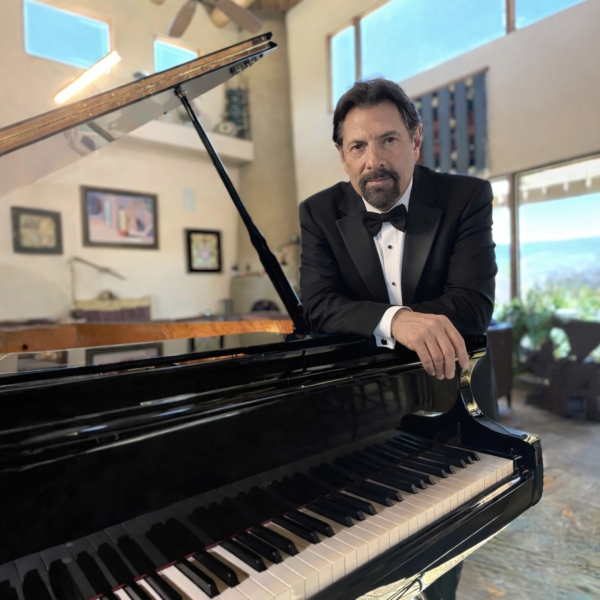
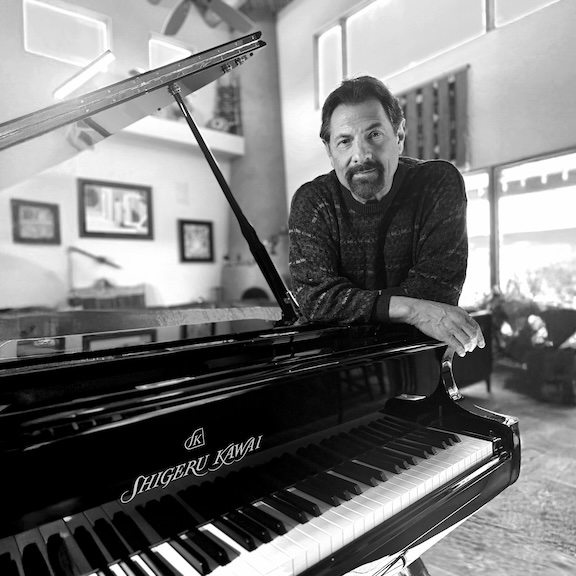
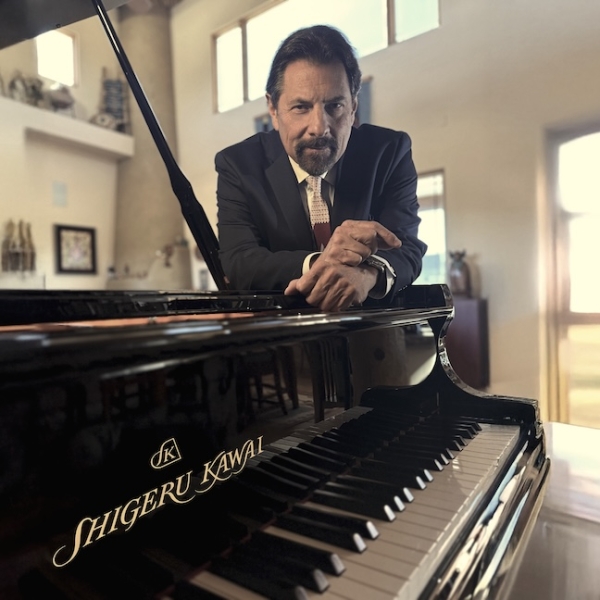
Richard Atkins is an artist I became familiar with when he sent me his debut album,
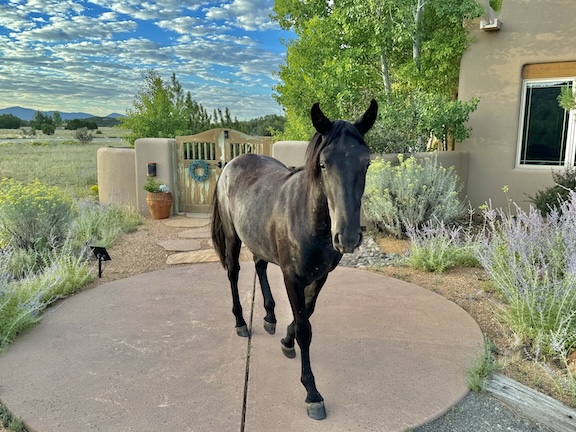
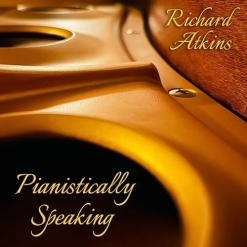
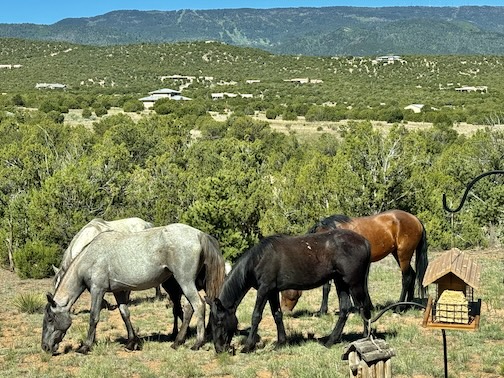
Pianistically Speaking, last year. I loved the album, so when Richard asked about doing an interview ahead of his Carnegie Hall concert debut this October, I was excited to get to know him better. An artist who has worn many different hats, Richard is also a photo-journalist and some of the photos that he sent for the interview are of the wild horses that visit his home on a regular basis. The interview is full of surprises, and I think you’ll enjoy getting to know Richard as much as I have. Enjoy!
KP: Hi Richard! How are things in New Mexico today?
RA: Hi, Kathy! It is always a pleasure to chat with you. New Mexico has been quite hot this summer, with sporadic rain during our usual monsoon season, which we desperately depend on to keep everything green and hydrated. Of course, the sunrises and sunsets are spectacular, and we are usually free from humidity, although this summer has been unusually humid.
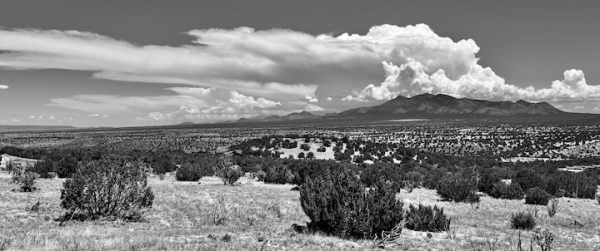
Luckily, we live at an elevation of 7,500 feet overlooking the Sandia Mountains, so we are generally about 10 degrees cooler than Albuquerque, which is only a short 20-minute drive away.
Another wonderful feature of our subdivision is that we have several groups of wild horses, some dating back to the Conquistadors. They simply appear in our front or back yard and peacefully graze on the grass. It is a phenomenal benefit to living here, and it came about entirely by accident. The horses wandered into the area and apparently decided to make it their home!
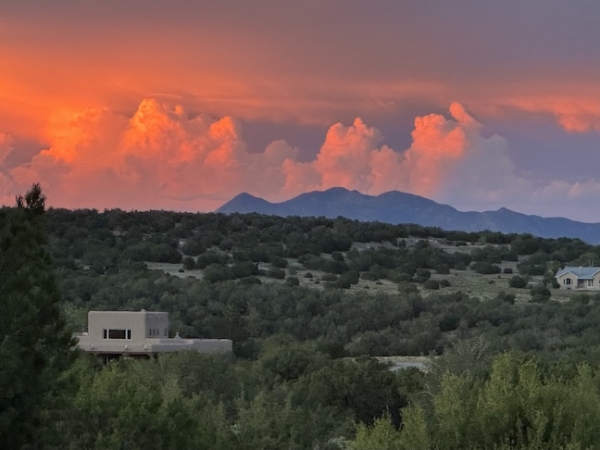
Richard's home is in the lower left of the photo.
KP: I remember that part of New Mexico from a trip quite a few years ago (not to your sub-division!). It was breath-taking - especially the elevation!
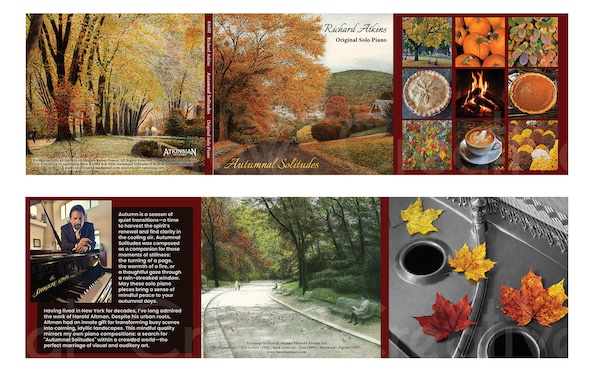
You are getting ready to release your second album, Autumnal Solitudes, in August 2026. I haven’t heard it yet, but I’m really looking forward to it! Tell us a bit about it.
RA: I am performing a solo piano concert at Carnegie Hall on October 24th, so I thought I would release an album with an autumnal theme. Autumn is a time to rejuvenate after the long, hot summer. The air becomes crisp, and the leaves turn a multitude of colors.
What better way to accompany that vision than with calming, original piano solos that evoke hot cocoa by the fireplace, leaves falling from the sky, and, in a manner of speaking, a renewed lease on life?
KP: That sounds really refreshing! You have also said that the album suggests reflection, maturity, and the passage of time. How does it differ musically and emotionally from last year’s Pianistically Speaking?
RA: I think the music on the new album is a bit more introspective and atmospheric, while still remaining melodically focused, with rich harmonies that tell a story. People have often told me that my music is very cinematic, and I agree with them.
A recent Instagram post of mine garnered more than 72,000 views using only 20 seconds of “Torn Apart,” the opening track from Pianistically Speaking. People from around the world responded, and each person seemed to imagine a different story within that short excerpt. Some envisioned loved ones who had passed away, while others described drifting on a cloud. Many said the music gave them a sense of hope and calm, even while living in such a chaotic world.
KP: It’s amazing to get that big of a response, and it must be wonderful to know you are calming many troubled spirits!
As you mentioned, you will be performing your solo debut concert at Weill Recital Hall at Carnegie Hall on October 24. I think that’s many musicians’ dream. How did it come about?
RA: The Carnegie Hall concert grew out of a very unfortunate situation. I had spent months organizing a New Mexico tour for Holocaust survivor Simon Gronowski, raising approximately $12,000 and securing venues that included the Lensic Performing Arts Center and the Albuquerque Academy Performing Arts Center. Unfortunately, Simon canceled a month before the performances, and I had to return every dollar that had been donated.
One of those donors was my former San Pedro Creek neighbor, Barry Debany, a financial investment adviser who had contributed thousands of dollars toward bringing Simon to New Mexico. After seeing everything unravel, Barry told me to consider his contribution “a coupon for the next Richard Atkins production.”
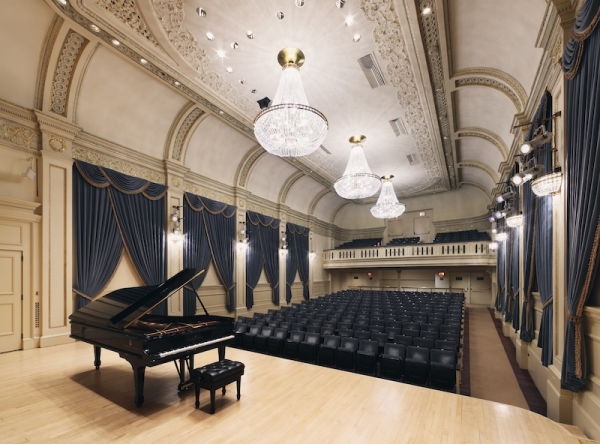
When I later explored Carnegie Hall and discovered that Weill Recital Hall was an intimate, 268-seat venue, Barry offered to underwrite the hall rental because he believes in my talent as a pianist and composer.
But then the project became something much larger than a recital.
After considerable research, I chose to partner with Education Through Music, or ETM, a New York City nonprofit that provides music education and instrumental instruction to underserved children. I asked ETM to select one of its most promising students to perform a solo during the concert and then join me in a piano duet.
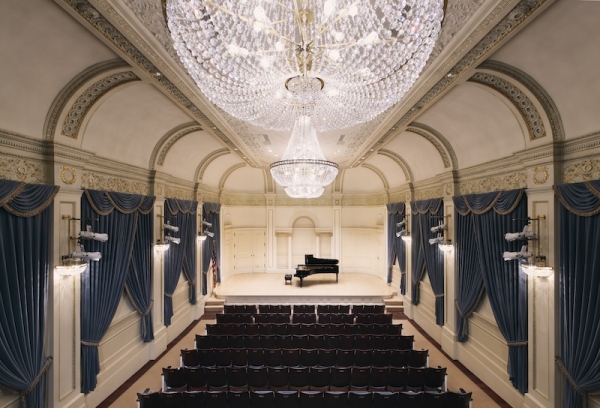
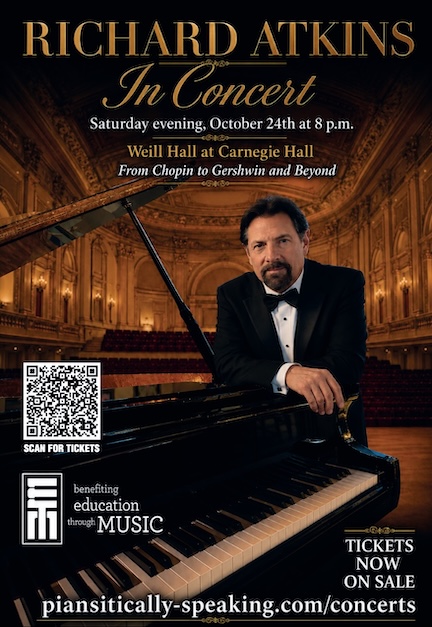
The concert poster and views of Carnegie Hall.
Barry subsequently arranged a very generous donation from the charitable fund he manages to support ETM’s work. The concert has now grown into something meaningful for a deserving young pianist, for a remarkable nonprofit organization, and, yes, for me as well.
KP: What does this performance represent to you personally after such a long and unconventional journey?
RA: I have been at this piano gig for more than half a century. There comes a time when you feel compelled to validate yourself publicly. After years of performing in restaurants, banks, department stores, hotel lounges, and cabaret rooms, what better way to prove what I can do than by performing in the hallowed halls of Carnegie Hall?
KP: I love that your program for the concert includes Bach, Beethoven, Chopin, and Debussy as well as film music, ragtime, original compositions, and your own arrangements. That’s quite a variety of styles and genres! What connects these different musical worlds for you?
RA: I have always gravitated toward music in general, whether it was The Beatles, Beethoven, or Scott Joplin. After all these years, my musical brain has developed a knowledge and love of myriad styles.
I think today’s audiences appreciate the diversity of my repertoire rather than sitting for 90 minutes and listening exclusively to standard classical fare. But do not get me wrong: once my date at Carnegie Hall was confirmed, I fell in love with classical music all over again.
That included not only the great composers you mentioned, but also many 19th- and early-20th-century composers I had never encountered before. Discovering their compositions was extremely gratifying because there are so many lesser-known composers who wrote extraordinarily beautiful music.
KP: I agree! I loved going through many, many music books and finding gems for my students to learn!
Has preparing for Carnegie Hall influenced the new music you are writing or changed your understanding of yourself as a performer?
RA: After my Carnegie Hall date was confirmed, I seemed to adopt a more modern or contemporary classical style in some of my compositions. It probably happened instinctively, knowing that I would be performing in such a hallowed hall.
Some of my Instagram followers have said things such as, “This sounds like it was composed 150 years ago,” which I consider a supreme compliment.
As for my understanding of myself as a performer, I am also a professionally-trained actor with extensive stage experience, as well as a produced playwright and screenwriter, so performing has always been in my wheelhouse.
However, the prospect of appearing at Carnegie Hall can be daunting when you know that so many famous pianists have graced its stages and that people may unconsciously compare you with some of those greats. I am sure my heart will be pumping a little faster on the day of the concert.
KP: Understandably so! One of the special elements of your Carnegie Hall concert will be the participation of the young pianist you mentioned earlier, Jason Afovi, through Education Through Music. Why was it important to include a young musician in such a personal milestone?
RA: That is a great question. I have experienced many detours that took me away from the piano, and it has taken me decades to reach this point.
Giving a young pianist like Jason the opportunity to perform at Carnegie Hall at such a young age is a way of passing the torch from my long journey to the beginning of his. My hope is that he will be able to recognize and fully realize his talent at a much younger age than I did.
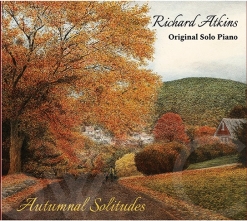
Click on the album covers to go to
Kathy's reviews. ("Autumnal Solitudes"
will be reviewed soon!)
KP: Tell us a bit about Jason and how you found each other.
RA: When I decided to partner with a music-focused New York City charity and selected Education Through Music, I asked its CEO, Janice Weinman, to find a piano student who had excelled through ETM’s programs and could perform one or two numbers at my concert.
At first, she said, “Well, Richard, I don’t know whether we have a pianist who is good enough to play at Carnegie Hall.”
I replied, “Keep looking.”
A short 24 hours later, she emailed me a video of Jason seamlessly performing a lovely piece for an adoring audience at an ETM event. After watching it, I called Janice and told her, “Jason’s got the gig!”
KP: After Carnegie Hall and the release of Autumnal Solitudes, where do you hope this new chapter will lead — more recordings, performances, theatrical projects, or something you have not yet revealed?
RA: My hope is to secure a music agent who will book me for concerts throughout the United States and abroad. For more than 20 years, I have also worked as a published travel photojournalist and have visited many wonderful places around the world. I love to travel and would be thrilled to return to some of those idyllic destinations to perform solo piano concerts.
After my recent Instagram post went viral, I gained fans from around the world, so my visibility as a performing pianist is finally growing.
I love releasing new albums, so that will certainly continue. I have also been developing a multimedia production called
Pianistically Speaking, just like the album. I would describe it as “Liberace meets Cirque du Soleil.”
In fact, I will be performing another concert at Keller Hall at the University of New Mexico on November 21st. That production will incorporate photography and video. I am also working with the artistic director of the New Mexico Ballet to choreograph three dance numbers set to my original compositions, and I will accompany a professional poet during her performance.
It will be a multimedia experience that remains centered around a single piano. Ultimately, I would love to attract investors and bring the concept to Las Vegas.
KP: That would be quite an undertaking, but it sounds like fun!
For quite some time, you presented yourself and your music through the identity of “The Hidden Maestro” on TikTok. Why did you remain behind that identity?
RA: My daughter, who is a content creator, thought that concealing my identity would add a sense of mystery and make people curious about who I really was.
I maintained that identity for about a year, but I recently revealed myself because I realized that if the public did not know who I was, how would people find, purchase, or listen to my music beyond the short clips I posted on TikTok?
KP: Good points!
RA: That realization was my primary motivation to reveal my identity. “The Hidden Maestro” created intrigue, but I eventually understood that people needed to connect the music with the person who had composed and performed it. It was time for listeners to meet Richard Atkins.
KP: Pianistically Speaking marked an important return to the piano for you. What did creating that album reveal about the musician you had become?
RA: It revealed that I had developed a unique and original sound that was recognizably my own. I think that is incredibly difficult to achieve when there are so many musicians in the world. When people hear my compositions and recognize my touch, I hope they can say, “Yes, that is a Richard Atkins piece.”
KP: I reviewed the album last year and am listening to it again now. I forgot how much I love the music! Was that your first album ever?
RA: I hate to admit it, but yes, it was. I had already been a professional pianist for more than half a century, but the economics of making a living, paying bills, and constantly searching for the next engagement prevented me from recording an album until a few years ago.
It was not that I did not want to record. I was simply too busy earning a living. I still think recording an album is something of a luxury because producing one can be very expensive.
KP: Agreed! You have described your musical journey as one filled with detours. How did your years in journalism, theatre, acting, playwriting, and screenwriting ultimately shape you as a pianist and composer?
RA: In some ways, I think being a pianist shaped those other pursuits even more than they shaped me. Since I was a pianist first, music taught me the rhythm of dialogue and how to write with a particular cadence.
I worked on two of my plays with Tony Award-winning playwright Mark Medoff, who wrote Children of a Lesser God. He pointed out that my dialogue had a pleasing rhythm, and that was one of the things that attracted him to my work. He directed my play The Men of Mah Jongg and served as dramaturg for my Holocaust-themed play DeliKateSSen, both of which I have now adapted for the screen!
My love of acting and theatre ultimately took me away from the piano for a time, but theatre gave my music a sense of dramatic form. A play begins with exposition, develops through rising action, reaches a climax, and concludes with a denouement. My music often follows a similar progression.
The theatrical work I have done taught me how to structure a narrative through music.
KP: Being a creative is a constantly evolving thing. Do you believe you play differently now than you would have played had you pursued a traditional concert career when you were younger?
RA: I think so. I had a very strict classical teacher at the University of Maryland: the renowned concert pianist Thomas Schumacher. As a 17-year-old freshman, I carried a very demanding load of classical repertoire.
However, I also minored in theatre and was exposed to Broadway composers, Gershwin, Stephen Schwartz, and many others. That exposure gradually shifted my focus away from exclusively classical music and toward more popular styles.
I believe the combination of my classical training and my love of many other styles has shaped the evolution of the music I perform and compose today.
KP: Your original music is often melodic, cinematic, and emotionally direct. Are you consciously trying to tell a story when you compose, or does the story emerge after the music has taken shape?
RA: I think the story is initially suggested by the chordal structure and melody during the composition process. Once I become immersed in a piece, however, it often seems to begin writing itself. It can feel as though I am being told which chord or melodic line should come next. It is an unusual sensation.
KP: I think that's what's referred to as "being in the zone"!
RA: Everyone has an individual process when it comes to composing. Sometimes I will decide to write a piece in a particular key because of that key’s resonance and how it relates to what I am feeling. The choices will also depend on whether I want to write a romantic ballad or something more uptempo.
KP: I have read that while growing up, you often hid the fact that you were a pianist from your friends and peers. Why was that?
RA: When I was younger, I was heavily involved in sports. I played baseball, basketball, and football, and that continued throughout high school. I genuinely wanted to become a professional athlete.
At the time, I did not think being a pianist fit with that sports-focused identity. I also knew that my football coach would not understand why I had to miss a day of practice on the field to attend band rehearsal.
KP: Haha! That’s probably very true! What changed that brought you out of the “piano closet”?
RA: When I started college at the University of Maryland, I did not receive an athletic scholarship. My parents wanted me to pursue pre-med, even though I had no interest in medicine, and I soon found myself taking botany and zoology courses designed for science majors.
I was also unable to secure housing in the dormitories and was forced to pledge a fraternity. In the 1970s, fraternity hazing was still common. Between the hazing, being locked out of the fraternity house by the other members, being sent on ridiculous scavenger hunts, and taking science classes that were far too difficult for me, I nearly flunked out during my first semester.
That signaled to my parents that I needed to focus on something else. I auditioned for the music school as a piano performance major and was accepted. At that moment, I suppose you could say I was completely out of the “piano closet.”
KP: How do you balance classical discipline with the freedom to compose music that is accessible to listeners who may not ordinarily seek out solo piano recordings?
RA: My classical training helped immensely in preparing me for my future as a composer. It was extremely intensive. I practiced three to four hours a day while still carrying 15 academic credits.
Those intensive studies paved the way for my present compositional style, which could be described as contemporary classical, neoclassical, classical crossover, New Age, or New Age crossover.
KP: Your music has recently begun reaching listeners throughout the world through social media. What has surprised you most about the international response?
RA: What surprised me most was the overwhelmingly positive response to only 20 seconds of music. I was amazed.
Thousands of people from every walk of life and from countries around the world described the music as beautiful, soothing, melodic, and Zen-like. Many offered similar reactions: it took them on a journey, transported them to another place, brought back memories of loved ones who had passed away, or helped them cope with the grief of losing someone.
It seems that the particular piece used in the Instagram post, “Torn Apart,” has connected universally with tens of thousands of people, much as songs such as “Ave Maria,” “Piano Man,” or “Yesterday” have connected with generations of listeners. I was simply blown away by the response.
KP: Do you have sheet music available for any of your music?
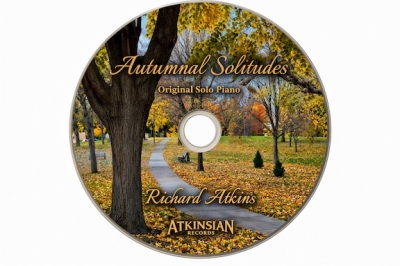
The layout for Autumnal Solitudes.
RA: Yes. I currently have sheet music available for “Torn Apart,” “French Café,” and “Ocean” from Pianistically Speaking. Since the Instagram post went viral, I have received many requests for both the sheet music and the CD!
KP: That’s great!
When did you become an official Shigeru Kawai Artist?
RA: When I began searching for my “forever” piano, I contacted David Reed, the director of Field Services for Kawai America and a Master Piano Artisan.
For those unfamiliar with the designation, a Master Piano Artisan is an elite title given to top-tier piano technicians who handcraft, voice, regulate, and tune high-end Shigeru Kawai grand pianos.
I already owned a small Kawai GE-1 baby grand that I had brought with me when I moved from New York to New Mexico, so I was familiar with and fond of the Kawai brand. I then began reading about Shigeru Kawai, the highest-end line of Kawai pianos, which are made entirely by hand.
I ultimately purchased a Shigeru Kawai SK-3, a six-foot-two-inch grand piano. When I flew to Los Angeles to play one, I discovered a richness of tone and responsiveness of touch that I had never quite experienced in another piano.
I began recording Pianistically Speaking using compositions I had written on my Shigeru. I then learned about the elite roster of official Shigeru Kawai Artists, which fascinated me.
As I continued making progress, receiving strong reviews for my album, and securing my Carnegie Hall debut, David gave me the wonderful news that I had been named an official Shigeru Kawai Artist.
KP: Here’s a “small world” anecdote for you! You mentioned buying your Kawai at Kim’s Pianos in Southern California, and I saw that you also mentioned Steve Rivera on your website. Steve works at Kim’s and is also one of my best friends! Did you buy your piano through him?
RA: Yes! Steve is one of the most fantastic, colorful, quirky, and knowledgeable people in the piano business, not to mention a wonderful pianist and composer. It was an absolute joy to meet him and purchase my Shigeru Kawai through him.
KP: As an official Shigeru Kawai Artist, what qualities do you look for in a piano, and how does the instrument affect the way you interpret or compose music?
RA: The qualities I look for in a piano include an even action across the keyboard that is neither too heavy nor too light, along with a clear and resonant tone.
A Shigeru Kawai has a wonderfully mellow tone, but it also has enough power and depth to handle a demanding Rachmaninoff or Liszt composition when needed.
I also value the quality of the instrument’s construction, including the use of different woods to achieve that exact tonal sweet spot and the five-year period during which Kawai ages its soundboards.
All of these qualities contribute to creating an exceptional Shigeru Kawai instrument. Some people rave about Fazioli and Bösendorfer pianos, but I will always be a Shigeru Kawai owner.
KP: You are approaching your seventieth birthday at a time when your musical career appears to be accelerating. What do you hope your story says to people who believe they may have waited too long to pursue something meaningful?
RA: I hope my story lets people know that if they have a dream, they should do everything in their power to pursue it, regardless of their stage of life, financial position, or current state of mind.
Some people may say, “I am too old to pursue my dream now.” But I never stopped thinking about mine. Through all the detours, disappointments, and hardships, I kept at it. I continued honing my craft, discovering new ideas and composers, and developing a new outlook on life.
I say this because I know many people who live with regret because they did not pursue their ultimate dreams. I will always encourage people to go after the dream, no matter what. You may fail, and you may very well succeed, but getting there will be half the fun. In the end, you will know that you tried and gave it your very best shot.
KP: That’s really inspiring!!! Thanks for sharing!
Many thanks to Richard Atkins for sharing his story with us! For more information about Richard and his music, be sure to visit
his website and his
Artist Page here on MainlyPiano.com.
Kathy Parsons
July 2026