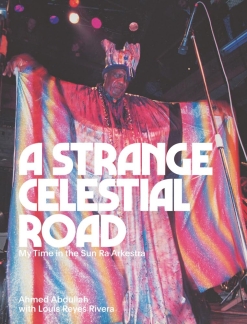
A Strange Celestial Road: My Time in the Sun Ra Arkestra
Ahmed Abdullah
2023 / Blank Forms Editions
Review by Steve Yip
A Strange Celestial Road: My Time in the Sun Ra Arkestra is some memoir! The author, Ahmed Abdullah, is a Harlem-born trumpeter, composer, and educator. He joined the remarkable Sun Ra Arkestra in 1975, performing with the ensemble for more than 20 years. And to continue, one must also understand and appreciate Abdullah’s memoir within the global context set around the legendary Sun Ra himself. Ra was a jazz composer, bandleader, and philosopher who fused ancient Egyptian symbolism, cosmic mythology, and helped thrust jazz into an avant-garde world of sound. And Ra was early into Afrofuturism.
So getting back to Abdullah’s career in jazz, which spanned over five decades of avant-garde innovation and community engagement. A pivotal figure in the New York loft jazz movement, Abdullah, with help from the activist poet Louis Reyes Rivers (see afterword below), outlines this special journey traveling on the “celestial road” in engrossing, detailed, no-holds-barred narratives.
In its first several pages, we are introduced to the author and his extensive backstory ... The book explains his immersion in Sun Ra’s cosmic philosophy (cited above), the rise of Brooklyn’s Black nationalist cultural institutions like The East, and his experiences at global events such as FESTAC ’77 in Nigeria. Abdullah reflects on his struggles with addiction, his embrace of Buddhism, and his evolving views on gender and politics, all while punctuating the narrative with stories of jazz catalysts like John Coltrane, Miles Davis, and Archie Shepp.
Abdullah’s experiences at the 1977 participation of the Arkestra in the Nigerian government-sponsored FESTAC ‘77 (the Second World Black and African Festival of Arts and Culture), a significant pan-Africanist cultural gathering of the diaspora, surfaced a new mindset for looking at music within the scope of an oppressive, racist America. At its conclusion of this atmospheric experience, to which he says, “When I left Lagos [the capital of Nigeria] at the end of February 1977, I was a changed man. The essential spirit of that experience is something I have carried with me ever since.”
From that point, he jumps forward into the next chapter on “The Loft Movement”. This is where it is moving -- where his musical criticism and commentary are shared within the framework of the political atmosphere of the times. The loft jazz movement came about in 1970s New York City as a grassroots response to the exclusion of avant-garde musicians from mainstream clubs, which were more interested in the commercial side of musical presentation and performances. This alienation caused many artists to form collectives -- artist-led organizations that emerged included formations such as the Jazz Composers Guild, Collective Black Artists, and unionization through groups like the Soho Artists Association.
The Loft Movement saw transformations of inexpensive downtown lofts—often in SoHo, the Lower East Side, and Greenwich Village—into inclusive performance spaces where they could live, rehearse, and present experimental music on their terms. And we are talking about free jazz, funk, classical, world music, and spoken word.
By the time one passes through the beginning chapters and into “The Loft Movement,” one begins to understand that this memoir is a true recollection. As you travel through his chronologies, Abdullah cites not just the neighborhoods he lived and traveled through but pinpoints the literal street addresses and building numbers! But much returned to the point as Abdullah recalls when Sun Ra left NYC for Philadelphia. Someone posed the question, “Where is Sun Ra these days?” The answer by another made the point, “I don’t know, but, wherever Sun Ra is, that’s where the music is.”
In the final third of the memoir, Abdullah reflects on Sun Ra’s declining health, his philosophy of transcending death, and the emotional shift in their relationship after Abdullah learns of his mother’s passing. The following bittersweet excerpt deals with the period leading up to Sun Ra’s passing in 1993.
After hanging up the phone I somehow managed to find Sun Ra’s room to tell him I want to cut the tour short due to these unexpected circumstances. Sitting in his wheelchair, he says little these days in comparison to years gone by. His condition now is one that has made me deeply anxious as it has created such a profoundly new relationship between us. My mentor, my musical and sometimes spiritual teacher, the person who could talk to me for hours on any subject known and unknown to man, woman, or Angel, is now someone I only play music with. His illness has given me an overwhelming sense of impending loss. For many years, Sun Ra had taught us that we had to do the impossible, which he’d say was to give up our death, our ownership of it, our submission to it. His philosophy was about expanding possibilities, envisioning cities without cemeteries. It was a philosophy of eternal things and immeasurable equations.
Abdullah also shares some interesting and intimate insights about other significant musicians he met and encountered besides the giants mentioned earlier. But one should grab this book!
An Afterword about co-author Louis Reyes Rivera (1945-2012)
The rich, flowing narrative, almost conversational style of the text that informs A Strange Celestial Road. It most likely can be attributed to the co-author of this memoir -- the late activist poet, storyteller, and teacher Louis Reyes Rivera. The manuscript of this memoir had been completed in the late 1990s, but it wasn’t published until 2023! Now, I have met Ahmed Abdullah at a book event at Revolution Books NYC in Harlem in 2024; however, I have known Louis Reyes Rivera for almost 20 years! Self-described as the “janitor of history,” Louis’s birthday has always been notated by me in other settings as he not only shares this significant date with Yuri Kochiyama, but also with Malcolm X!
August 2, 2025


