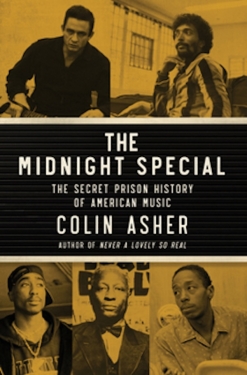
The Midnight Special: The Secret Prison History of American Music
Colin Asher
2026 / W.W. Norton & Company
Review by Steve Yip
The Midnight Special: The Secret Prison History of American Music by Colin Asher is powerful, compelling, and profound. The author has produced a work that doesn’t play around with generic sonic appreciation. Yes, it deals with music and the incarceration experience in five chapters, focusing on four Black and one white artist(s). I recently heard a prominent classical musician remark that music reveals much about the individual creative artist... well, there’s a lot more to learn from this standup work that peels away the underbelly of U.S. society that has shaped and informed our musical tastes. Frankly, let’s face it, most of us have a suppressed recognition of such inconvenient facts.
The Midnight Special (borrowed from a song by Lead Belly) is a standup work that educates and outrages. The author doesn’t dwell in clinical scholasticism. In five chapters, Asher dives into the stories of four Black (Lead Belly, Ike White, Elmo Hope, and Tupac Shakur) artists and one white singer (Johnny Cash) -- in folk blues, jazz, hip-hop, and country genres -- celebrated and unsung.
The grotesque legacy of slavery and its subsequent reincarnation by another name in the Jim Crow South is brought out in “‘The Midnight Special’ and Other Southern Prison Songs” -- the first chapter, where we find out about how Huddie Ledbetter, better known as Lead Belly, is a giant icon of American folk roots music. In his latter years, living in New York City, he was befriended and visited by countless blues OG’s like Sonny Terry and Brownie McGhee, and the likes of Woody Guthrie, Pete Seeger, and Gordon Parks.
The truth of Ledbetter’s origin story is that he was deliberately exploited and stereotyped by the cultural prospector John Lomax, who found Ledbetter singing on a prison chain gang. Lomax had begun documenting and recording the music from prison work/chain gangs of the Jim Crow South in the 1930’s. John Lomax, while celebrated as an important folklorist and musicologist, was, frankly, a cultural predator who controlled and exploited Ledbetter by consistently intimidating Ledbetter to perform in concerts throughout the country in prison motif. (John Lomax’ son, the equally celebrated folklorist and co-collector Alan Lomax, is a much more empathetic figure.)
“Sounds from Rikers Island” outlines the very complicated ups and downs of jazz pianist and recording artist Elmo Hope up against a racist culture of criminalization, demonization, and marginalization of jazz artists in the 1950/60’s. In this one chapter, one will be stunned to learn how many well-known jazz luminaries have spent time at Rikers Island -- victimized by openly racist and official policies specifically targeting jazz (mainly Black) artists in New York City back in the day.
“Changing Times” captures the truly heartbreaking story of prison artist and multi-faceted instrumentalist Ike White, where I found myself just shaking my head in anger and dismay. Here we find an artist who emerges from, and survives, the years of neglect and brutal incarceration during the tumult of the Sixties and the politicized prisoners movement. And upon final liberation from the hellholes of the California prison system, Ike’s story arrives at a tragic end.
“At San Quentin” finds a fascinating story about Johnny Cash. But the truth would be found that this country music personality -- despite many serious mishaps and accidents resulting from erratic drug-induced behaviors -- was able to avoid any long-term tenures with the criminal justice system because -- unlike the other subjects of this book -- he wasn’t Black. Nevertheless, Cash made his mark with his live (and recorded) performances in front of prison audiences at San Quentin, at Folsom, and other prisons. This endeared him to many in and out of the carceral experience. This also compelled him to advocate for prison reform.
“Me Against the World” reveals something very touching about rapper Tupac Shakur’s origin story. It begins with the saga of his mother, Afeni Shakur, a former political prisoner and one of the New York Panther 21. Tupac Shakur lived a traumatic life thread that led to his cultural notoriety, which began with a brutal beating by Oakland cops. The very recent news of the conviction of Duane "Keffe D" Davis, the shotcaller responsible for Tupac’s murder (30 years ago), deserves a look at the irresolvable contradictions of our criminal injustice system.
For music enthusiasts whose love of the music drives them to discover more... this book delivers the honest context that informs the annals of American music. Asher has brought forth an accessible read that peels back the disturbing and outrageous harshness of the criminal justice system that has victimized and haunted so many generations from oppressed communities, especially those who retained and shared their humanity through musical expression.
Heather Ann Thompson, the author of Blood in the Water: The Attica Prison Uprising of 1971 and Its Legacy, said of this book, “... despite America’s seemingly insatiable desire to silence human beings behind its highest and thickest prison walls, the music that so many nevertheless manage to create inside... has transcended those brutal spaces.”
And lastly, did we say that The Midnight Special: The Secret Prison History of American Music by Colin Asher is a Finalist for the National Book Award for Nonfiction?
October 17, 2026


