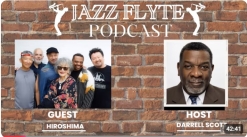
Applause and accolades must go to Cleveland’s Darrell Scott. He does the
Jazz Flyte Podcast, a little-known Cleveland-based jazz music podcast. The podcast on video was titled,
The Band That Bridged Two Cultures. Thanks to the good offices of the YouTube.com algorithm, it brought attention to this podcast that featured Dan Kuramoto and June Kuramoto -- two key founders of the Asian American-driven jazz-hybrid fusion band, Hiroshima. And its introduction confidently asked, “What happens when music becomes more than entertainment? What happens when it becomes identity, culture, and a bridge between communities?”
There was so much history to be learned from this podcast’s deep dive. The podcast revealed a conversation that went beyond performance and musicality. It revealed a crucial historical context -- the socio-politico locomotive of the Asian American movement, which birthed a musical genre that defied categorization and overcame cultural barriers. This exciting hybrid music as it synthesized jazz, R&B, Latin, and reggae rhythms with Japanese traditional instrumentation. The instrument in question is the
koto -- a traditional Japanese court instrument. Its unique and iconic sound embodies Hiroshima’s identity.
If I can plagiarize myself, in my very early contributions to MainlyPiano.com, I reviewed the band’s seminal self-titled 1979 album, “Named after the Japanese city of Hiroshima, which was destroyed by the first dropping of the atomic bomb by the U.S. and that killed over 90,000 to 166,000 human beings, the band’s emergence in 1974 was tied to the movements for ‘self-determination’ and recognition, and in solidarity with the greater social movements that engulfed this country in the late 60’s and early 70’s. Their appearances were always enthusiastically welcomed in Asian American communities on the West and East Coasts.”
In the podcast, band leader, visionary, and innovator, Dan Kuramoto brought home the life experience that shaped the social justice-informed vision of a music like no other:
“I grew up on the Eastside of Los Angeles, an area known for poverty and gang violence, but to me, it was a wonderful multicultural experience where you just had to know the rules of the neighborhood... As a third-generation Japanese American (Sansei), I carried the impact of history. My parents and grandparents were placed in internment camps during World War II... Yet 125,000 people on the West Coast were imprisoned. The government used it as a scapegoat, ignoring the fact that Japanese immigrants had built major agricultural and fishing industries here, like draining the swamps in the Sacramento Delta using centuries-old techniques... That's why a core theme throughout our band's history has been social change, social justice, and the embrace of humanity through music.”
Dan further did not waste his breath with empty rhetoric, instead expounding on those defining influences that drew from the African American cultural experiences:
“At that time, we were heavily influenced by groups like Earth, Wind & Fire, Santana, Marvin Gaye, and Aretha Franklin. We wanted to create our own unique voice. Our main goal as a band was to express our cultural identity and break down negative, two-dimensional stereotypes of Asian Americans through our music ... We eventually played at the Watts Towers Jazz Festival and became the first non-Black group to headline the event. That performance brought us significant attention, including from producer Wayne Henderson...
“Musicians have always led that path. For me, Marvin Gaye's ‘What's Going On’ is one of the most important records ever because it reached the entire planet asking what we're doing to each other as human beings. Donny Hathaway and Earth, Wind & Fire were huge inspirations too—Maurice White introduced the kalimba on stage and brought a social-political connection to the music.
“Our career would not have taken off at all if Black radio hadn't embraced us. Stations like BK Kirkland in San Francisco, local stations in Los Angeles, and the entire WHUR network in DC made the astounding decision to embrace us as a core act from day one.”
Koto virtuoso June Kuramoto began her training with the koto very early on. She spoke of surmounting cultural barriers from within the community and obstacles posed by the mainstream music industry to locate the signature sound of the koto in Hiroshima’s unique blend of music:
“I dove into classical training all the way through. But in junior high, kids can be tough. Friends would ask, ‘Hey June, why do you play Grandma's music?’ Meanwhile, I was getting into The Temptations, The Miracles, and R&B. I was teased for loving this classical instrument, but in my heart, I hoped that if I could introduce it to younger folks in a contemporary setting, they might appreciate its beauty. In Japan, the koto was strictly a revered court instrument for the emperor until the 17th century, unlike the taiko drums, which were folk instruments. Doing anything outside of classical performance was heavily frowned upon.”
With hit tracks like "Taiko" and "Dada," Hiroshima achieved international acclaim, earning respect from jazz legends such as Chick Corea, Stanley Clarke, and James Moody. June Kuramoto was awarded a prestigious 2024 National Heritage Fellowship by the National Endowment for the Arts (NEA).
Darrell Scott closes the interview by suggesting that their multi-decade journey across cultures deserves to be captured in a dedicated coffee-table book. June humbly reflects on these accolades, attributing their longevity to the collective contributions of past and present band members.
Hiroshima’s journey warrants more serious recognition: as a pioneering Asian American fusion group, they seamlessly incorporated traditional Japanese instruments (koto, shakuhachi, taiko) with modern music by bridging two cultures together, and informed by a social justice sensibility.
The Jazz Flyte Podcast session with the Kuramotos is rich and deeply deserving of your attention, making its modest YouTube view count all the more frustrating. It deserves more love and exposure.
Postscript: Hiroshima consists of Dan Kuramoto (saxophone, flute, keyboards, shakuhachi), June Kuramoto (koto), Kimo Cornwell (keyboards), Dean Cortez (bass guitar), and Danny Yamamoto (drums and taiko). Hiroshima is done with resting and has begun some limited touring. In August, they will be in Temecula, CA, then move eastbound to Detroit, Cincinnati, and Cleveland. In November, they will be visiting Virginia. Go check their schedule at their website
here.