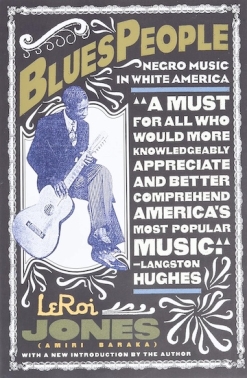
Blues People: Negro Music in White America
LeRoi Jones (aka Amiri Baraka)
1999 / Harper Perennial
Review by Steve Yip
Listen, folks. After watching the movie Sinners, which revolves primarily on the Delta Blues as a vital cultural and musical anchor of its story, it got me picking it up another old book, first read it at least 30-odd years ago -- Blues People: Negro Music in White America by the poet, playwright, and commentator LeRoi Jones, later to be known as Amiri Baraka. This book is something that should experience a revival, as in many ways, this is indeed an important exposition about how the blues and jazz developed as it aligned with the back-and-forth motion in how Black people into the American consciousness.
First published in 1963, Baraka explained by tracing the Black experience from enslavement to emancipation, to the appearance of the formerly enslaved Africans found in vast, disparate locales, plantations, and farms throughout the deep South into one people. This historical incubation -- found with the melding of Black people’s cultural heritage -- also appeared and manifested with music and “... the beginning of blues as one beginning of American Negroes...”
Of course, today we do not refer to the Afro-American people as Negroes, but that was the accepted terminology in those earlier days. What’s especially revealing was how Baraka locates the various historical nodal points in how the music emerged, developed and evolved from the bubbling cauldron of Reconstruction and later the Great Migration. Especially enlightening is how Baraka explains that blues was considered dirty and unwashed by an emerging middle class which sought legitimacy in the eyes of white America, and eventually it and its progeny like jazz and popular rhythm and blues, was able to firmly plant its roots as a foundational, cultural heritage in modern U.S. society.
From my perspective, this second reading of the 1963 edition was an exhilarating experience itself, which had sections and writing segments I found to be rather dense and requiring rereading; nevertheless, I found this book to be informed with scholarly precision and infused with some pointed and illuminated commentary throughout. Without going too deeply into it here, one may go to Wikipedia. It has a thoroughly mindblowing breakdown of the book chapter by chapter. And see what you think.
As an artist and social critic, Baraka has raised eyebrows, but for those who hold such retrograde views, they must admit to the monumental work represented by Blues People: Negro Music in White America. Yes, book blurbs serve as marketing tools, but there is no bullshit when Langston Hughes’ describes this book as, “...a must for all who would more knowledgeably appreciate and better comprehend America’s most popular music, Negro in origin--blues based--but now belonging to everybody.”
Reissued in 1999 with a new introduction to which Baraka wrote, "The music was the score, the actually expressed creative orchestration, reflection of Afro-American life ... That the music was explaining the history as the history was explaining the music. And that both were expressions of and reflections of the people."
There should be a revival of interest in Blues People: Negro Music in White America, (post Sinners) especially in these dangerous times when forces from on high and about are actively extinguishing (among many other things) real history through book bans, assaults on African American and other ethnic studies on campuses, discussions on equity, inclusion and multi-culturalism, and critical thinking in higher education.
Blues People: Negro Music in White America is not just insightful, culturally impactful but invigorating. The 1999 edition is by Harper Perennial and can be found at your favorite neighborhood online book dealer. Take my word, this was an exciting read (and go see Sinners too).
July 25, 2025


