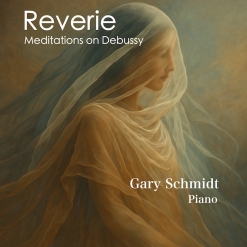
Reverie - Meditations on Debussy
Gary Schmidt
2025 / Gary Schmidt Music
28 minutes
Review by Kathy Parsons
Reverie - Meditations on Debussy is a collection of six piano solos composed by Claude Debussy (1862-1918) and performed by pianist/composer Gary Schmidt. Debussy is often referred to as an “Impressionist” composer, but he hated the term. Considered to be one of the most influential composers of the late-19th and early-20th centuries, Debussy’s “Clair de Lune” is likely his best-known work (and is included on this album!). Debussy is often quoted as saying “Music is the space between the notes,” and urged people to truly listen to the music rather than just hearing it. Gary suggests experiencing the album in a “quiet, contemplative place” and really focusing on it to fully appreciate the beauty and nuances in the music.
A Colorado resident for quite a few years, Gary Schmidt was born and raised in Canada. He was largely self-taught until college (Tyndall College and the Royal Conservatory of Music - both in Toronto) and went on to win many impressive awards for his classical performances as well as his original compositions. Gary’s motto is “Enhancing Life Through Music,” something he tries to do every day. He released his first “official” album, Landscapes of the Heart, in 2016, and this is his sixth album (plus a number of singles).
Reverie - Meditations on Debussy begins with “The Girl with the Flaxen Hair” (“La fille aux cheveux de lin”), the eighth in Debussy’s first book of preludes and written in 1909 or 1910. One of Debussy’s more popular pieces, Gary plays it with grace and an elegant touch. “Voiles (Veils)” is quite a bit more abstract and darkly “impressionistic.” Gary plays it very expressively with rich tonal colors and a sense of mystery. “Clair de Lune” (“Moonlight”) is Debussy’s most-popular piece and is the third movement of his Suite Bergamasque. He composed the piece in 1890, but it wasn’t published until 1905 with the rest of the Suite. One of classical music's most recognized and popular works, it is known for its tranquil and dreamlike melody. Played to perfection, Gary also released the piece as a single. “The Sunken Cathedral” (“La cathédrale engloutie”) was published in 1910 and was included in Debussy’ first book of preludes. It is based on an ancient Breton myth in which a cathedral, submerged off the coast of the Island of Ys, rises up from the sea on clear mornings when the water is transparent. Very descriptive and quite a bit darker than the other pieces on the album, it tells a fascinating story that Gary relays with drama, expression and mystery. “Footprints in the Snow”(“Des pas sur la neige”) is also part of Debussy’s first book of preludes and hints at some early jazz chords and more abstract rhythms. “Reverie” is likely Debussy’s second-best-known piece and one of my own favorites both to play and listen to. Composed in 1890, it was one of the first of Debussy’s pieces to make an impact. Gary keeps it warm, dreamy and very expressive, and it’s my favorite track on the album.
Reverie - Meditations on Debussy is available from Gary’s website as well as to stream and download on Amazon and Apple Music/iTunes and streaming platforms including Spotify and Pandora. Highly recommended!
November 21, 2025