Hi Everyone!
Another quick month has flown by! This is the first newsletter I’ve done on my new PURPLE iMac! My old one was so overloaded that it moved at a crawl. I’m still getting the new one set up, but what a breeze it is to use!
Health-wise, I’m doing fine and am VERY happy to say I’m not going to need any radiation treatments - a HUGE relief! Onward and upward!
The first American piano builder was John Behrent of Philadelphia. He built his first piano in 1775.
The first cast iron frame for the piano was introduced in 1825 by Alphaeus Babcock of Boston. This allowed for much greater string tension and higher playing volume.
Franz Liszt performed the first solo piano recital in Rome in 1839. Before then, pianists played between the acts of plays or between the performances of orchestras or chamber groups. Liszt also started the tradition of playing the piano on a bench rather than on a hard-backed chair.
New Reviews: I’m thrilled to say that many excellent new albums have been reviewed in July and some more great ones are coming up in August. I’m sure you’ll find some favorite artists there as well as some new ones to explore. I also reviewed Robin Spielberg’s new songbook and Steve Yip reviewed a classic book by LeRoi Jones/Amiri Baraka. You can find them all
here.
In 1903, the Society of American Piano Manufacturers burned a 50' high pile of square pianos in Atlantic City. The reason they gave was that they wanted to stimulate the sales of the newer piano models. As a result, square pianos are now quite rare.
The first "baby" grand piano was built in about 1860 by Henry Lindeman. He called it a "cycloid" piano. It was Steinway who began calling his smaller grands "babies."
Piano tuning was one of the first professions open to blind people.
New Interview: I posted a very interesting interview with guitarist/composer Michelle Qureshi in July. I'm sure you’ll enjoy getting to know her better as much as I did! I’m building a pretty long list of interviews to do in the coming months, so be watching for those! Michelle’s interview is
here.
The piano is the only instrument ever made whose physical appearance is often more important to the owner than its musical qualities.
The Wheeler and Wilson Co. of Connecticut experimented with a combination sewing machine and miniature organ. A woman was supposed to be able to sew and play music at the same time.
The 1900 Sears, Roebuck and Co. catalog offered violins for $2.50-9.60; guitars for $2.70-10.80; and banjos for $1.75-25. They also offered one model of a piano for $98 plus shipping.
August Birthdays: Here is a partial list of August musical birthdays:
1 - Peter Calandra
4 - Jeanette Alexander
5 - Marshall Barnhouse
6 - Derek Mount
8 - Tom Carleno
9 - Elias Haddad
10 - Valerie Romanoff
11 - Lawrence Blatt
12 - Ryan Marvel
13 - Edmond Paul Nicodemi
14 - Tim Glemser
15 - Pam Asberry, George Skaroulis, Rupam Sarmah & Steve Benjamins
17 - Kate Moody
18 - Jim Wilson
20 - Shoshana Michel & Beth Hilton
22 - James Woolwine
23 - Sherry Finzer
26 - Marc Enfroy
27 - Paul Adams, Suzanne Doucet & Richard Carr
28 - Michael Hoppé & Ken Elkinson
30 - Wendel Werner
Happy Birthday, one and all!
From about 1916 to 1925, almost every concert pianist of any prominence in the US made player-piano rolls.
In the 1850's, Joseph P. Hales started the practice of making cheap pianos and stenciling any name the distributors wanted on them. These are still referred to as “stencil brands.”
Hired pianists provided the "sound" for the silent movies of the early 20th century.
August Music Holidays and Observances: If you get bored during the month, here are some holidays and observances you can celebrate!
August 3-9: Elvis Week
August 2: National Rap Music Day
August 9: National Polka Day
August 11: Hip Hop Day; World Steelpan Day
August 12: Vinyl Record Day
August 24: International Strange Music Day
August 26: Musical Yoga Day
August 28: Radio Commercial Day
August 29: Record Store Day
No fewer than 1098 patents for items related to the piano were granted during the period from 1825-51. Most of the patents came from England and France, but there were others from Austria, Bavaria, Belgium, and the United States. Only 264 such patents were granted before then.
A drop of a half step in a piano's pitch (for example, from C# to C), causes a drop in the total tension on the piano of about 5,000 pounds.
King Leopold I of Austria had a harpsichord in every room of his palace so that he could try out any musical ideas that might come to him.
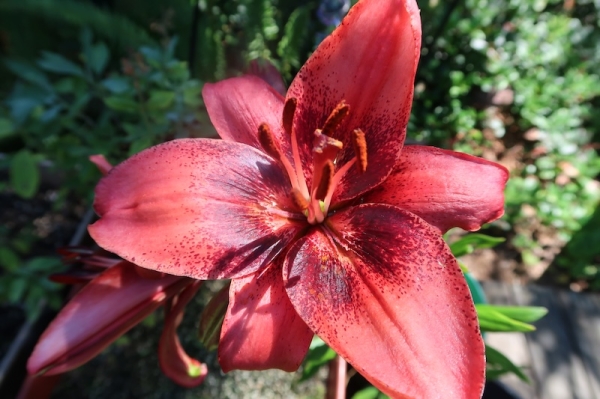
I think that about covers it for this month! The photos are of some of the lilies, daisies and petunias that have been gracing our yard and deck this summer. Have a great August!
Kathy
The pianoforte made its public debut in England on May 15, 1767, between the acts of the play, "The Begger's Opera."
In the early 1900's, dime stores had sheet music counters. Pianistic salesgirls were hired to demonstrate music as well as to entertain the customers.
Several devices have been invented over the years to automatically turn pages for pianists, but for some reason, none of them caught on. The iPad helps, but it isn’t automatic!
To the best of my knowledge, the "trivia" items are true, but I can't guarantee it.