Greetings as we head into Fall! (Really???)
August was an extremely busy but very productive month. I’ve been catching up with reviews and sheet music proof-reading after all of the medical “stuff” and am finally getting back on top of things. I’m really glad I don’t have to figure out how to schedule 40+ piano lessons a week as the kids go back to school! Been there, done that a whole lot of times! Anyway, here is the September issue of Pianotes. I hope you enjoy it!
Early pianos had 54 keys, while today's piano has 88. There are several piano makers who add additional keys to give their most expensive pianos more resonance.(Stuart and Sons in Australia has 102-key and 97-key grands, and some Bosendorfer pianos also add keys to the bass.)
Franz Liszt performed the first solo piano recital in Rome in 1839. Before then, pianists played between the acts of plays or between the performances of orchestras or chamber groups. Liszt also started the tradition of playing the piano on a bench rather than on a hard-backed chair.
Sergei Rachmaninoff, the Russian pianist and composer, could reach 12 white keys. He could play a left-hand chord of C, Eb, G, C, and G. Try it!
New Reviews: I think I broke my record for new reviews in August! Twenty-six new recordings were reviewed - sixteen albums and ten singles! I also reviewed Fiona Joy Hawkins’ new songbook and Steve Yip reviewed a book by Ahmed Abdullah as well as a single. Lots of new stuff to check out! You can find it all
here.
Pianos built from about 1850 until the 1890's had seven octaves, ranging from the lowest A to the highest. In the 1890's, an additional three notes were built into the treble, giving the piano its standard 88 keys.
Piano hammers were originally covered with leather. Cloth, sponge, and tinder were all used as replacements. In 1826, a patent was granted for covering the hammers with felt.
The earliest German upright pianos were called pyramid pianos because of the symmetrical shape.
New Interview: Steve Yip edited a new interview with Jamel Mims, the bilingual hip hop artist who performs as MC TingBuDong. It’s a very interesting follow-up to the interview Steve did with Jamel the end of 2022. You can find the interview
here.
I’m working on interviews with Peter Kater and Rob Korb and hope to have those ready to put up soon. Check back during the month and see what’s new!
Germans developed the universal piano fingering of numbering the fingers 1 (thumb), 2, 3, 4, 5 ("pinky"). The old English system was X (thumb), 1, 2, 3, 4.
Square pianos were the most popular style of pianos in American homes in the early 1800's. This was at least partly because their shape was the easiest to move by covered-wagon---the primary means of transporting goods for greater distances at that time.
The Chickering Piano Factory, which was completed after Jonas Chickering's death in 1853, was the second largest building in America at the time. (The White House was the biggest.)
September Birthdays: Here is a sampling of musical September birthdays!
3: Craig Urquhart & Jace Vek
4: Eric Chapelle
5: John Paris
6: Carol Parsons (Mom's 95th!!!) & Kimberly Haynes
7: Ron Korb
9: Jill Haley & Craig Einhorn
10: Matias Baconsky
11: Ed Bazel & David Tolk
12: Unita Akins
13: Seay, Jordan Buetow & David Mauk
14: Amy Lauren
17: Michael Dulin
18: Adrian Webster
19: Lisa Swerdlow
20: John Jarvie
21: Dick Metcalf
22: Amy Janelle & Chuck Wild (Liquid Mind)
24: Michael Debbage, Steven Cravis & Stephen Cairns
25: Tom Ameen
26: Bill Leslie , Justin Levitt, & John Albert Thomas
27: Richard Carr
Happy Birthday, one and all!
The ruling clergy of the Massachusetts Puritans was strongly opposed to the use of organs in church. Music could be played in private homes, but not in church.
Yamaha started exporting pianos to The US in the late 1950's. Many of those pianos literally fell apart until the Japanese manufacturers were able to develop glues and other materials that would hold up in US climates.
There were no more than twelve music shops in London in 1750. In 1794, there were 30; and by 1824, there were 150!
September Music Holidays/Celebrations: Nothing too exciting this month!
All Month: Classical Music Month & International Square Dancing Month
9/8-13: Line Dance Week
9/17: International Country Music Day
9/20: National Dance Day
9/25: National One-Hit Wonder Day
9/26: Record Store Day
9/29: Broadway Musicals Day
Pianoforte Magazine was the first publication to contain nothing but piano music. It first appeared in London in 1797. As a promotional come-on, each weekly issue contained a promissory note signed by the publisher. After someone had bought 250 copies and had 250 of these notes, they were supposed to be redeemable for a "Brilliant and elegant Pianoforte, far superior to many instruments sold for 25 guineas each." It is unknown whether or not anyone was able to trade in the coupons for a new piano.
When he died, Glenn Gould, one of the greatest pianists of all time, left half of his estate to the ASPCA and the other half to the Salvation Army.
The grand piano that Broadwood and Sons sent Beethoven in 1817 still didn't have any metal in its frame. Beethoven was widely known for breaking strings when he played, and his pianos didn't last long without the strength of an iron frame. As more keys were added to the keyboard, the tension on the frame was increased even more. Once the iron frame was installed, the piano could withstand tension of 18-20 tons.
Wishing everyone a great September as we go into Fall. Fall tends to be the nicest time of year on the coast, and we’re hoping for a little more sunshine and a little less wind! Enjoy, wherever you are and we’ll meet back here next month!
Before you go, here is some "bonus" trivia and some photos I took around our yard.
Kathy
For about twelve years during the 1820's and early '30's the compositions of Henri Herz sold more than those of any other composer and publishers paid him more than four times as much per page as they did nearly anyone else.
Even though he left Hungary at the age of nine and could never speak a word of Hungarian, at a concert in Budapest in January 1840, a number of Hungarian dukes came onstage and presented Franz Liszt with a richly jeweled sword in the name of the nation, the symbol of service or nobility.
Clara Schumann was the first performer to play Beethoven's sonatas for a concert audience. She did this in 1837, about seventeen years after the composer's death.
Viennese pianos of the 1790’s had a range of five octaves, from F 2 1/2 octaves below middle C to F 2 1/2 octaves above middle C. All of Mozart’s and most of Haydn’s piano music are contained within this range, as is Beethoven’s music until 1804.
In what has to be one of the stranger uses of a piano, Swiss sculptor Jean Tinguely created his "Homage to New York" from an old piano and other junk. It was meant to satirize modern technological civilization, and blew itself up at the Museum of Modern Art in New York in 1960. It obviously didn't operate as planned, and caused a fire at the museum to the horror of many distinguished guests and patrons.
In 1900, there were 7000 piano manufacturers in The US, including families who made pianos in their homes. One out of every six people in America was involved in some aspect of the piano business.
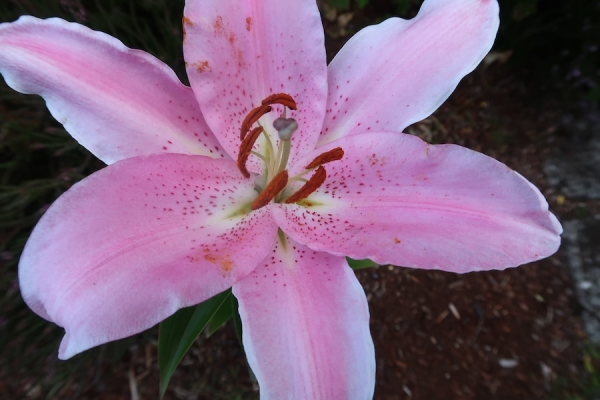
lily

snow peas
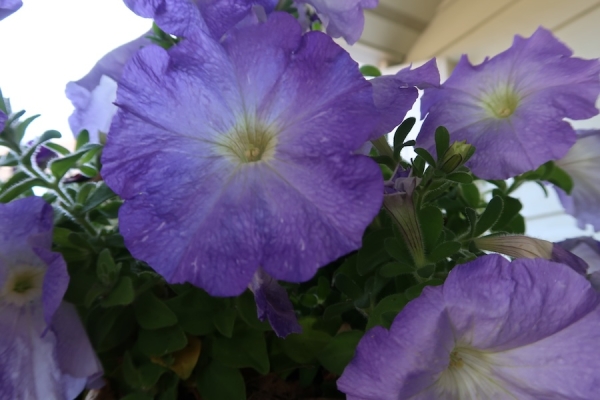
petunias
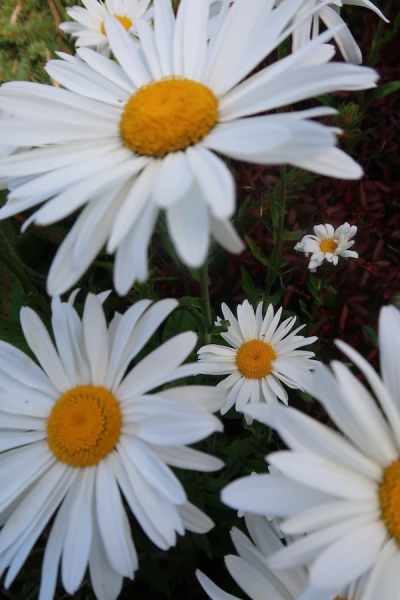
daisies
To the best of my knowledge, the "trivia" items are true, but I can't guarantee it.


