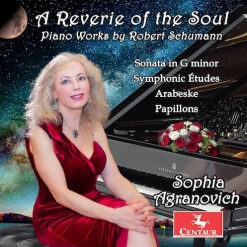
A Reverie of the Soul - Piano Works by Robert Schumann
Sophia Agranovich
2026 / Centaur
68 minutes
Review by Kathy Parsons
A Reverie of the Soul - Piano Works by Robert Schumann is the twelfth album (plus some singles) by multi-award-winning pianist, Steinway Artist, recording artist, educator, producer, and artistic director Sophia Agranovich. Known world-wide for her exceptional virtuosity and sensitive expression, Fanfare calls her “a bold, daring pianist in the tradition of the Golden Age Romantics…a tigress of the keyboard.” I have reviewed several of Sophia’s releases over the past eight years or so, and she has become one of my favorite classical pianists. Known primarily for her recordings and performances of music from the Romantic Era (approximately 1830-1900), A Reverie of the Soul is a collection of piano solos by German composer Robert Schumann (1810-1856) that includes one of his three piano sonatas (Sonata #2 in G minor, Op.22), his thirteen “Symphonic Etudes (Op. 13),” “Arabeske in C Major, Op 18” and “Papillons. Op. 2.” From a whisper of tenderness and grace to full-on piano pyrotechnics, Ms. Agranovich handles it all with (apparent) ease that is beyond impressive.
The liner notes for the album are a must. Written by Sophia Agranovich, they include a brief but concise bio for Robert Schumann as well as a history of the music itself and Sophia’s thoughts about each track - great information that adds depth and understanding to your enjoyment of the music.
The album begins with Schumann’s four-movement Sonata No. 2 in G minor, Op. 22, which was composed between 1833 and 1838. The first movement is marked “as fast as possible,” and consists of a wide variety of musical styles from very quiet and peaceful to flashy and fast to an almost jazz style - very impressive! The second movement, “Andantino,” is very different and may reflect Schumann’s affection and tenderness for Clara Wieck, his future wife. I love the quiet, reflective quality of this movement! The third movement is much shorter and is called “Scherzo,” which translates as “joke.” Fast and highly-syncopated, it’s a wild ride! The fourth movement is a “Rondo,” goes through many stylistic changes, and Ms Agranovich handles them all with ease.
The thirteen Symphonic Etudes, Op. 13 are structured in a theme and variations format and became one of Schumann’s most ambitious and technically-demanding works for the piano. Quoting the liner notes: “The variations explore a wide emotional and textural range from delicate, lyrical explorations to ferocious, virtuosic outbursts, showcasing his dual personas - Eusebius’s tenderness and Florestan’s fire. Far more than a display of technique, the work delves into rich polyphonic complexity, making the piano sound orchestral in scope. It remains a cornerstone of Romantic piano literature and a pinnacle of Schumann’s pianistic legacy.”
Arabeske, Op. 18 is a beautiful example of Schumann’s tender, dreamy side. It has its more dramatic and energetic moments, too, but most of the eight-minute piece is very accessible.
19 Papillons, Op. 2 was composed when Schumann was 21. The title translates as 19 Butterflies. Inspired by the masked ball scene in Jean Paul’s novel, Flegeljahre (The Awkward Age), the nineteen pieces reflect a sampling of many dance forms of the time including waltzes and polonaises. Again quoting the liner notes: “Papillons is a psychologically rich gem of early Romanticism. It reveals many hallmarks of Schumann’s mature style: literary allusion, structural innovation, technical brilliance, psychological complexity, and a seamless fusion of Classical tradition with Romantic imagination. Papillons flutters at the threshold between fantasy and reality - an insightful early portrait of Schumann’s inner world.”
A Reverie of the Soul - Piano Works by Robert Schumann is another brilliant work of art from Sophia Agranovich. It is available on CD and can be streamed and downloaded on Amazon; it is also available to stream and downloaded on Apple Music./iTunes as well as on many streaming platforms including Spotify and Pandora. Very highly recommended to classical music lovers and those who appreciate incredible piano performances!
March 23, 2026