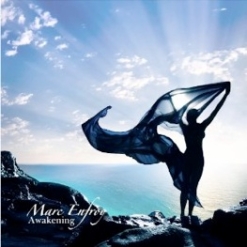
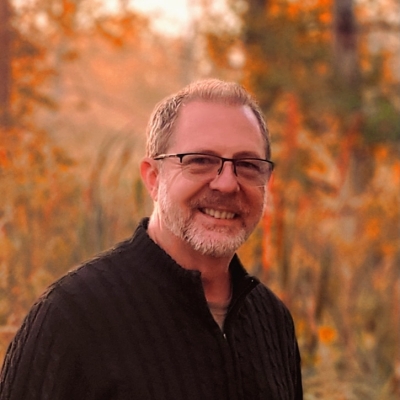
One of the most rewarding things about doing MainlyPiano.com as well as working on
Wind and Wire (1998-2000) and SoloPianoPublications.com (2000-2008) has been getting acquainted with artists who were just getting started and following their careers for going on thirty years! I reviewed Marc Enfroy’s debut album,
Unbounded, in 2008 and did my first interview with him in early
2009. Six albums and
another interview later, here we are! Marc has a wonderful new album out called
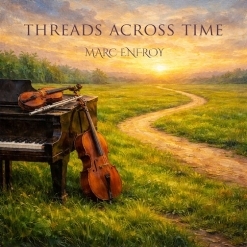
Threads Across Time, and I thought it was a good time to do a third interview to talk about it. Enjoy the interview and be sure to check out the album!
KP: Hey Marc! How are things in Michigan today?
ME: Things are good! We’re getting into that time of year when Michigan starts reminding you that Fall is here to stay. I’m doing well and enjoying having the new album finally out in the world.
KP: Speaking of the very beautiful Threads Across Time, how is it doing so far?
ME: Thank you! It’s only been out on the streaming services for a little over a week, so it’s still very early, but the response has been really encouraging. What’s meant the most to me are the messages from people telling me what particular pieces bring up for them. “An Unbroken Thread,” especially, has gotten one of the strongest emotional responses I’ve ever had to a piece of music.
KP: That doesn’t surprise me at all. It’s so emotional and full of positivity!
This album has quite a story behind it. Let’s talk about it in general first, and then I’ll ask you about some specific tracks.
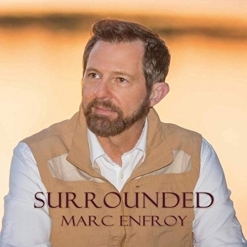
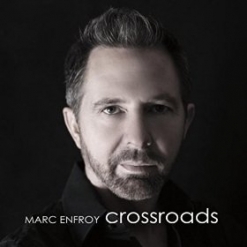
Click on album covers to
go to Kathy's reviews.
ME: The album really grew out of becoming a grandfather and thinking differently about time, family and what gets passed from one generation to the next. You start noticing moments you might have rushed past when you were younger. You watch your children become adults, you hold a grandchild, and suddenly you’re thinking about your own parents and grandparents.
So,
Threads Across Time became an album about those connections. It’s about children and grandchildren, memories, people we miss, and the hope that something of us continues in the people we love.
KP: I have thoroughly enjoyed reviewing all of your albums over the years, but I think this is your strongest album yet.
Some of the tracks sound like they have a full string section, but only Joni Fuller is listed for violin, viola and cello. How did you make it sound like a full string ensemble?
ME: Joni is basically a string section all by herself! She records multiple passes of the violin, viola and cello parts, and those performances are stacked and spread out to create the impression of a much larger ensemble. I also experimented with different positioning and mixing techniques to create more depth. It’s amazing how large the string section sounds when all of those individual performances come together.
KP: To be fair, we should also mention the excellent flutist, Gina Luciani, who also plays on the album. Have you worked with either of these artists before?
ME: I had worked with Joni before on my album Surrounded, so I already knew what an incredible musician she was. Gina was new to my music with this project. She has a beautiful sound and was very good at capturing the delicate, expressive quality I wanted from the flute. They both brought a humanity to the album that you just can’t get completely from virtual instruments.
KP: You have released two versions of the album - the “Official” version and a “Collector’s Edition.” What’s the difference between the two?
ME: The official album has ten tracks and is the version available on Spotify, Apple Music and the other streaming services. The Collector’s Edition has those ten pieces plus two bonus tracks, “What Stays With Me Still” and “Safe at Home,” that aren’t available for streaming. It also includes the “Composer’s Notes” booklet, where I tell the story behind each piece and include artwork created specifically for the album.
KP: You also have a limited number of signed CDs. Are those doing well? I really miss having the discs, cover artwork and liner notes to refer to that were so much a part of CDs. I’m also fearful that a huge amount of music is going to simply disappear since there are so few physical products anymore.
ME: I’ve been really happy with the response to the CDs. I intentionally kept the pressing fairly small, and it’s been nice discovering how many people still value having something physical. Streaming is incredibly convenient, but there’s something different about buying an album, looking through the artwork and liner notes, and having that physical connection to the music.
KP: I agree. You can also come back to a recording at various stages of your life and see if it has the same effect as it did earlier.
I love the “Composer’s Notes” booklet that you sent me digitally. I don't believe you've ever offered anything like this before. What made you want to create it?
ME: Because this album was so personal, just putting ten titles next to ten pieces of instrumental music didn’t feel like enough.
Instrumental music leaves a lot open to the listener, which I love, but I also thought some people would have a richer experience knowing the back story of each piece. So the booklet gave me a place to tell those stories, talk about the people and memories behind the music, and pair each one with its own artwork. It became a companion to the album.
KP: The words “thread” and “threads” appear in several of the song titles as well as the title of the album. Why that particular word?
ME: I kept coming back to the idea that there are invisible threads connecting us across generations. Things get passed along without anyone consciously deciding to pass them along: kindness, values, mannerisms, ways of looking at the world, even little habits.
Time changes everything around us, but some of those connections stay really strong. Once I started thinking of them as threads, the word became a natural way of describing the whole album.
KP: Tell us a little bit about your kids and grandkids - ages, how many, do they live close to you, things like that.
ME: I have three sons and now six grandchildren, which is still a little hard for me to believe! The grandkids are 10 months, 2, 4, 4, 6 and 8. Four boys and two girls.
Two of them live out of state, so unfortunately I don’t see them nearly as much as I’d like. The other four are here in Michigan.
They’re all completely different personalities. We have everything from soft-spoken and gentle to total rabble-rousers and pretty much everything in between. They’re a lot of fun, and becoming a grandfather definitely had a big influence on this album.
KP: That’s so nice! They are lucky to have such a caring grandfather!
“A Good Heart: Echoes” first appeared as “A Good Heart” on your 2011 album, Unconditional. What inspired you to do a new arrangement of the piece?
ME: I always liked the melody and it’s been one of my more popular pieces since it was programmed by Music Choice years ago. With this album being so centered around children, grandchildren and what we pass forward, the subject of being good-hearted seemed like a natural fit. We all hope our kids and grandkids grow up to be kind and good people, so it suddenly felt relevant again.
I also knew I could do things musically that I couldn’t do very well fifteen years ago. So I kept the heart of the original piece but rebuilt it with richer orchestration, real strings and a more mature arrangement. That’s why I called it “Echoes.” It’s the same idea coming back years later, but heard from a different place in life.
KP: Tell us about “My Wish for Your Life.”
ME: That one comes from thinking about what you actually wish for your children and grandchildren once you’ve lived long enough to know that nobody gets an easy life.
You obviously want them to be happy, but more than that, you hope they find people who truly love them, that they stay kind, that they have the strength to get through the hard periods and that they become comfortable with who they are. The music is my way of putting all of those wishes into something without having to say them.
KP: One of my favorite tracks is “First Breath.” What inspired that one?
ME: “First Breath” is about the moment when a child comes into the world and suddenly everything has changed. I wrote it shortly after my oldest son had his first child so that was definitely the inspiration. I was trying to convey in music what my son was experiencing.
There’s such a mix of emotions in becoming a parent. There’s tenderness and vulnerability, but at the same time this enormous rush of love and wonder. I tried to let the music move between those feelings.
KP: You have said that “An Unbroken Thread” is “the emotional centerpiece of the album.” What is the meaning of the title and what inspired the music itself?
ME: I wrote it thinking about my children and grandchildren and the things that pass quietly from one generation to another. A value you try to live by. A way of treating people. Something small you do that years later you recognize in one of your children.
Eventually we're gone, but some part of us keeps moving forward through other people. That’s the unbroken thread.
When I finally heard the piano, flute, strings and orchestra come together, it affected me much more strongly than I expected. I got really emotional listening to it. That’s when I realized it had become the heart of the album.
I’ve heard from so many listeners saying that piece hits a spot inside that brings them to tears, in a good way. Seeing how so many people’s feelings mirror my own has been amazing. It’s one of the reasons I love writing music so much.
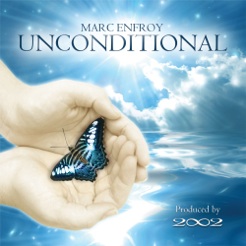
Click on album covers to
go to Kathy's reviews.
KP: Music truly is a universal language!
“The Thread Goes On” is the last track on the “official” version of the album and has a very interesting story/theme. Tell us about it.
ME: That one takes the idea a step into the future. I imagined a time when I’m no longer here and my grandchildren are grown. Maybe one of them comes across this album, reads these notes and realizes that their grandfather wrote this music while thinking about them when they were very young.
There’s something moving to me about the possibility of music making that connection across time. So the title is really the final thought of the album. We come and go, generations change, but the thread goes on.
KP: Tell us a bit about the two bonus tracks.
ME: The two are “What Stays With Me Still,” which is solo piano, and “Safe at Home,” which is just piano to start, but around the middle you’ll hear soft strings, clarinets and choir. They’re both quieter, more intimate pieces.
I felt that “The Thread Goes On” was clearly the ending of the ten-track album. Once that piece finishes, the story has really reached its conclusion. The other two still belonged emotionally to the world of the album, but they felt more like an epilogue. That made them perfect bonus tracks for people who wanted to stay with the album a little longer.
KP: It’s been seven years since your last album, Surrounded. What have been some of your musical projects during that time?
ME: I definitely didn’t stop making music. Between Surrounded and this album I released around a dozen singles. That was all driven by streaming being so focused on individual songs vs albums. My wife, Sharon, and I also wrote an EP of wedding music for our son’s wedding, which was a really special project for us.
Threads Across Time was the first collection in a long time that clearly felt like it belonged together as one complete story, dedicated to my family.
KP: I’ve enjoyed going back and re-reading the interviews we did in 2016 and 2009. How has your music evolved over the years?
ME: Reading those interviews is a little like finding old photographs!
In 2009 I was still very new at this and learning by trial and error. My first album, Unbounded, was new age piano mixed with orchestral samples. Listening back to it makes me cringe. By the time my Crossroads album came out in 2016, I had gone in almost the opposite direction: bigger, darker, more cinematic, with rock influences and vocals.
Today, I’m in the modern classical or cinematic lane which is where I think I’ll stay for the foreseeable future. Melody and emotion are still the two things I care about most, but I’ve become better at orchestration, counter melodies, thematic writing, things like that. I also think the subjects I write about have changed as I’ve gotten older. I’m probably looking inward more and paying closer attention to family, memories, and the passing of time.
KP: You mentioned in both interviews that you weren’t doing any live performing. Has that changed?
ME: Nope! Some things never change.
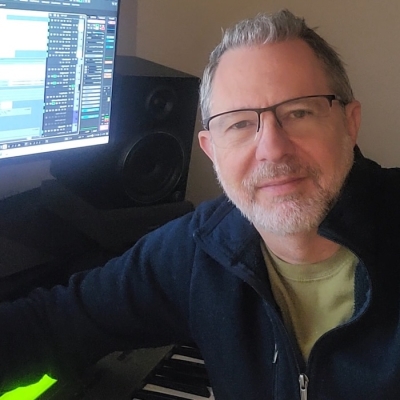
I love composing and producing music, but I’ve never had a desire to tour or become a performing pianist. The studio is where I’m happiest. I can spend hours obsessing over an arrangement, but ask me to spend those same hours practicing for a concert and suddenly I have somewhere else I need to be.
If I ever put on a concert, I wouldn’t be the one playing, that’s for sure. I’d have to hire it out to a performing pianist.
KP: Who and what have had the biggest influence on your music?
ME: My influences have changed over the years. Early on I was listening to people like Enya, Tim Janis, George Winston, James Horner, Jim Brickman, and that definitely shaped the melodic side of what I do.
I also love artists who combine melody with a lot of emotion and drama. You’d never know it listening to my music but I’m a huge fan of Amy Lee’s band, Evanescence.
Genre really doesn’t matter much to me. If there’s a strong melody and it makes me feel something, I’m probably going to find aspects of it that influence me.
KP: If you could have any three wishes, what would they be?
ME: At this point in life they’d probably be pretty simple ones. Good health and happiness for the people I love. More time with my family, especially the grandchildren who live farther away. And enough years and inspiration left to keep making music that means something to somebody.
I think I would have given you a much more elaborate answer twenty years ago!
KP: Is there anything else you’d like to “talk” about?
ME: Mostly just thank you for still being here to ask me questions seventeen years after our first interview!
One of the nicest parts of releasing this album has been hearing from people who have listened to my music for ten or fifteen years, along with people who discovered it last week. You put music out into the world and never really know where it goes or what part it becomes of someone else’s life.
I’m very grateful that people are still listening. And I’m already thinking about what comes next.
Many thanks to Marc Enfroy for doing this interview! For more information about Marc and his music, be sure to visit
his website and his
Artist Page here on MainlyPiano.com.
Kathy Parsons
September 2026